Three Pedals, Four Doors: TMGPS Celebrates Supersedans

Nobody expects a sedan to launch off the light with a perfect one-two shift. Sedans are the perfect sleepers, and that’s why we love ’em. Automatic crossovers may dominate the automotive landscape in the decade to come, but these TMGPS members refuse to sacrifice fun for practicality.

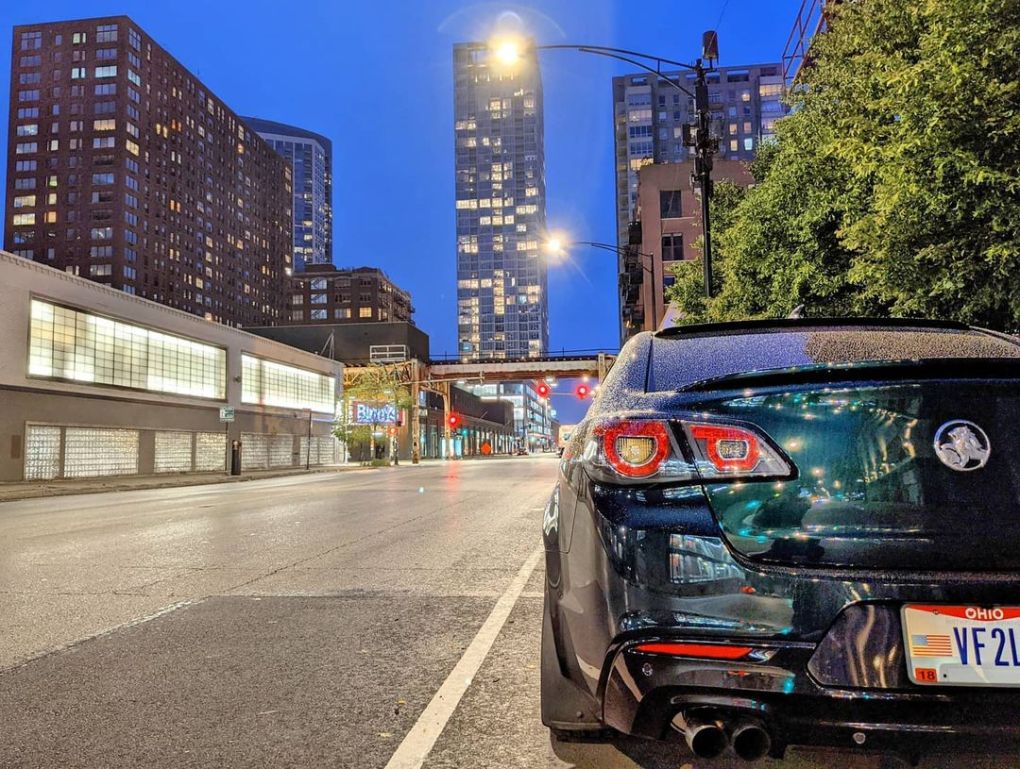
Ross’s Six-Speed Chevrolet SS Sedan

Holden’s last stand mercifully made it to American shores in its fullest form: available with a manual transmission, and coated in a rainbow of Good Colors. Regal Peacock Green is the best spec, in this author’s opinion, and we’re grateful Ross tags us in his track attack pics.

Ruben’s Manual BMW M3 Sedan

Ruben’s not afraid to drive his M3 — a grand credit, considering these rock-solid expressions of the pure BMW experience command ever-higher prices in this modern age. Catch him on-course in the Pacific Northwest, and watch for his tags on our feed.

Andrew’s Three-Pedal BMW 540i Sedan

Throw it back one generation to rediscover the bridge between vintage BMWs and the zenith of the marque. Andrew’s executive sedan is all-business, hustling through six gears at time attack events hosted by BMWCCA.

Marumi’s Five-Speed Mitsubishi Lancer Evolution X GSR

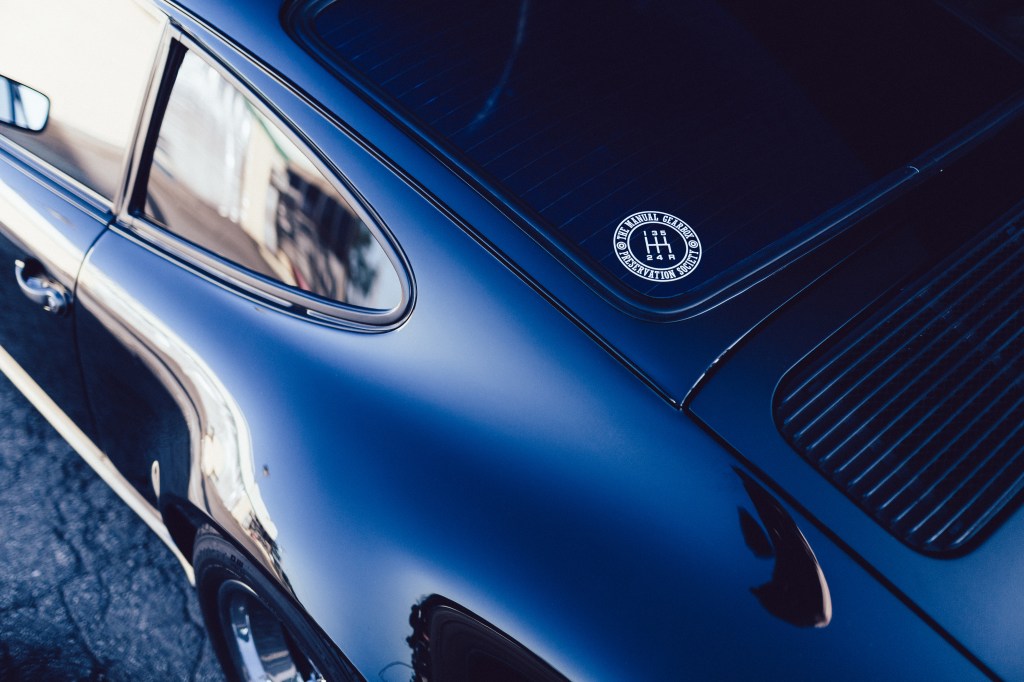
How often do you see an unaltered LanEvo? Marumi’s car highlights the stark contrast of black on white, with vents and strakes that pop against a clean exterior ending in a flying wing. His TMGPS Insignia Decal takes its place of honor in the rear quarter window, letting traffic know that this is indeed the better version of the car.

Scott’s Five-Speed Isuzu Stylus XS

Smallest in the bunch, Scott’s Isuzu packs an outsized punch, with a twin-cam engine hungry for revs past 7000 rpm. Yes, this is the car that had Handling by Lotus, tuned by legendary engineer Roger Becker himself. Look for Scott’s Stylus at the curated RADwood display at the Greenwich Concours d’Elegance.

@highmileage is a world-traveling automotive historian. follow adam barrera on instagram.

JEEP MAGNETO TESTS AN OPTIMISTIC TMGPS THEORY

It feels like a lifetime ago that I was in Vegas chatting with Mark Allen, Jeep’s design shepherd (and my former boss), over some rye whiskey about the plausibility of an electric Wrangler which utilized traditional gearing and axles. It had been on my mind as the topic of manuals on electric cars comes up pretty frequently at TMGPS, and we had just seen the Ford/Webasto Mustang collaboration debut earlier that day at SEMA. Like most of my conversations with Mark, it was somewhat nerve-racking; either he’d dismiss the idea with stinging disapproval or he’d dismiss the idea with a mischievous grin, make a sarcastic joke, and change the subject. To my delight, and most likely thanks to the Manhattans, he was unusually receptive to the conversation. He told us about a friend of his who had built something along those lines and that it had worked fine. “You can start in 1st or you can start it in 4th, doesn’t matter! You don’t need the gears, but they’re there if you feel like going through them…” he said. I asked if there was any benefit to having the low range gearing when it came to crawling with a hypothetical electric Jeep. To which he responded with a shrug, and then changed the subject. I turned to my old pal Chris Piscitelli who had been responsible for the Moab Easter Jeep Safari builds for the past several years and asked what he thought about doing a build. “They don’t really let us do manuals anymore. A lot of the journalists don’t know how to drive them… besides, they’re moving me to Dodge when I get back.” EJS got canceled due to Covid-19 about six months after that conversation.

Many electric car experts will be quick to point out the on-demand torque of a BEV as a means for shedding the weight and complexity of a multi-ratio gearbox. As someone who loves driving manuals, but is also very interested in electric cars, the ultra-low ratios found in something like a Jeep Wrangler has always seemed like a great opportunity to experiment with the idea of slowing down typically high-RPM electric power with more traditional drivelines. The fact that Wrangler is also required to operate at highway speeds, and has limited space for batteries, means that there could also be a benefit to using the higher-end ratios to eke out some extra wheel speed from a motor that is turning at a lower RPM and potentially using less of the stored energy.

I was thrilled last night when I found out that the Jeep Magneto concept would in fact mate an electric motor to the stock JL 6-speed manual and drivelines! I have to say I’m a little salty we didn’t get a heads-up, and a chance to slap a TMGPS decal on it, but hopefully they’ll make it up to me with a chance to drive it one day. Until then, I can’t wait to find out how it does out on the trail and whether or not it’s an idea that makes sense for future production products.

Rather than crafting a homestyle copy pasta of the press release, I’m going to just let the fine folks at Jeep describe it in exactly the way they penned it.

“The Jeep Wrangler Magneto concept is a fully capable BEV that is stealthy, quiet, quick and an unmistakable rock-climbing force. Jeep brand engineers and designers have created a zero-emission vehicle with Jeep 4×4 capability that provides new levels of efficiency, environmental responsibility, and performance on- and off-road.
 
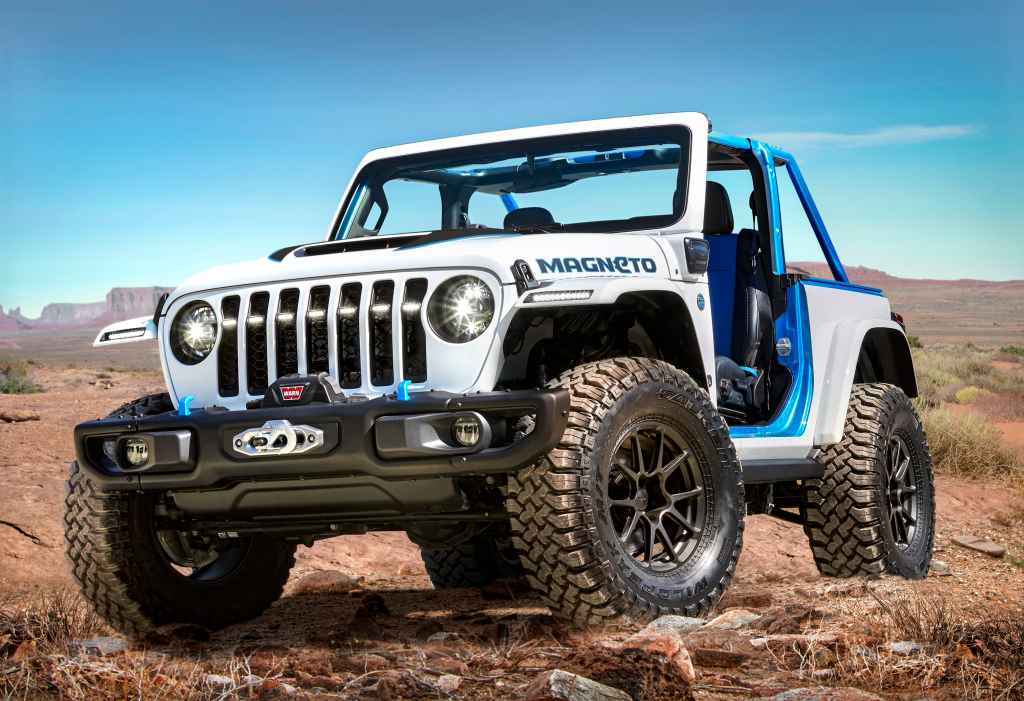
Based on a two-door 2020 Jeep Wrangler Rubicon, the Jeep Magneto uses a custom-built axial flux electric motor that operates up to 6,000 rpm. The e-motor is connected to a six-speed manual transmission, creating a unique manual-electric powertrain with a clutch that operates as it would with an internal combustion engine. In quick-shift scenarios, the e-motor engages regen upon clutch engagement to prevent rev-hang.
 
Comparable to the 3.6-liter Pentastar V-6, the compact e-motor is tuned to deliver up to 273 lb.-ft. of torque and 285 horsepower. Intentional calibrations developed during testing help the Magneto’s powertrain emulate the driving experience of the V-6, matching not only torque but also horsepower. During moderate driving, the performance difference between the V-6 and the Magneto’s unique manual-electric powertrain is negligible except for near-silent operation.
 
When greater acceleration is needed, the e-motor delivers all 273 lb.-ft. of torque without the need to build up revolutions per minute. The Magneto concept runs 0-60 mph in 6.8 seconds.
 
Powering the Jeep Magneto’s e-motor are four battery packs with a combined power of 70 kW/h, running an 800-volt system. The lithium-ion batteries are distributed around the Wrangler to balance weight on the four wheels. One pack replaces the Wrangler’s mid-ship fuel tank, another is mounted opposite the fuel tank location, the third pack sits atop the e-motor under the hood and the fourth pack mounts in the space normally used for a rear storage compartment, also using space typically occupied by the exhaust muffler.
 
An inverter derived from race cars converts DC power to AC for the high-tech motor. The batteries, a vehicle interface box and the battery control module all reside in waterproof enclosures to maintain the Wrangler’s 30-inch water-traversing capability. A 12-volt battery powers existing systems, such as the radio and lighting. A second 12-volt battery serves as an auxiliary power unit (APU) for accessories, such as the winch. A DC-to-DC converter charges both 12-volt batteries, allowing long-term operation of accessories to power a campsite or an unexpectedly long winch operation. Unique mounts secure the battery packs for harsh driving and custom skid plates protect the packs from potential strikes to the undercarriage while traversing harsh terrain.
 
A 10-kw high-voltage heater keeps the fully open-air passenger compartment comfortable.
 
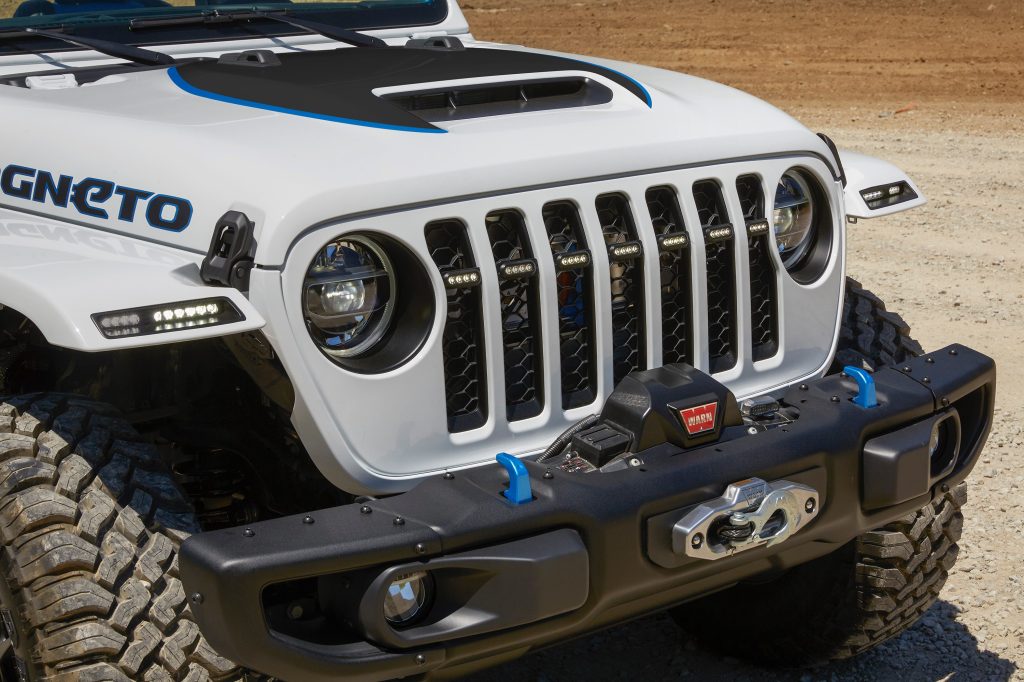
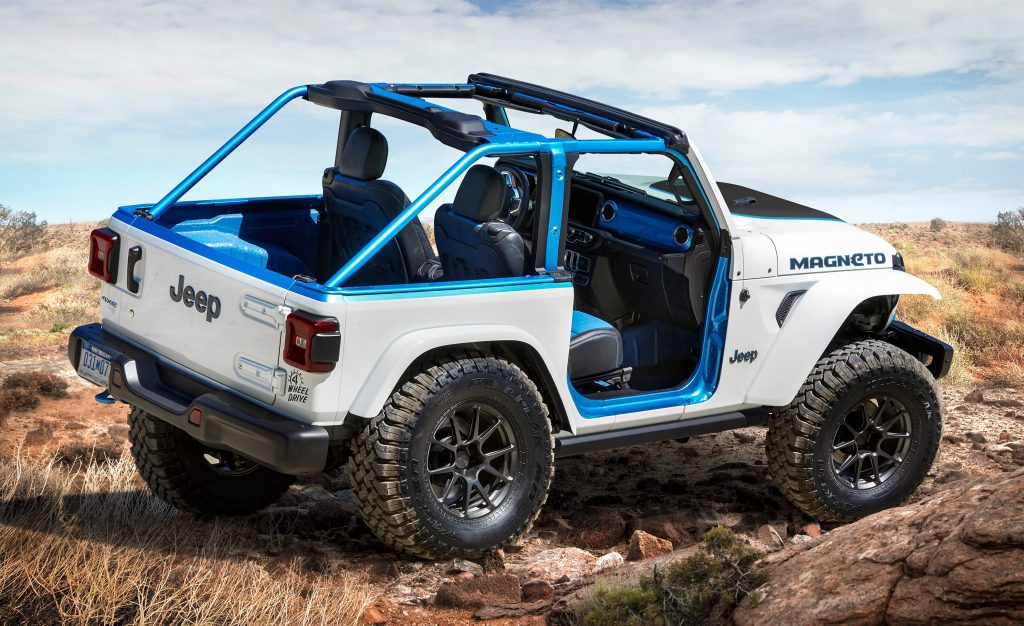
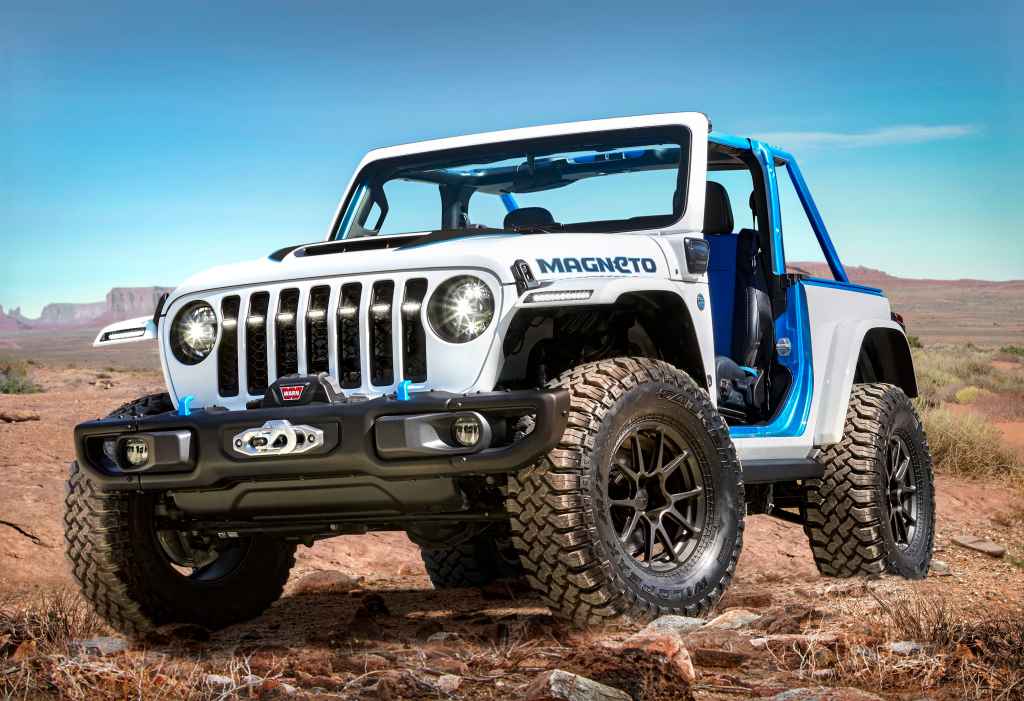
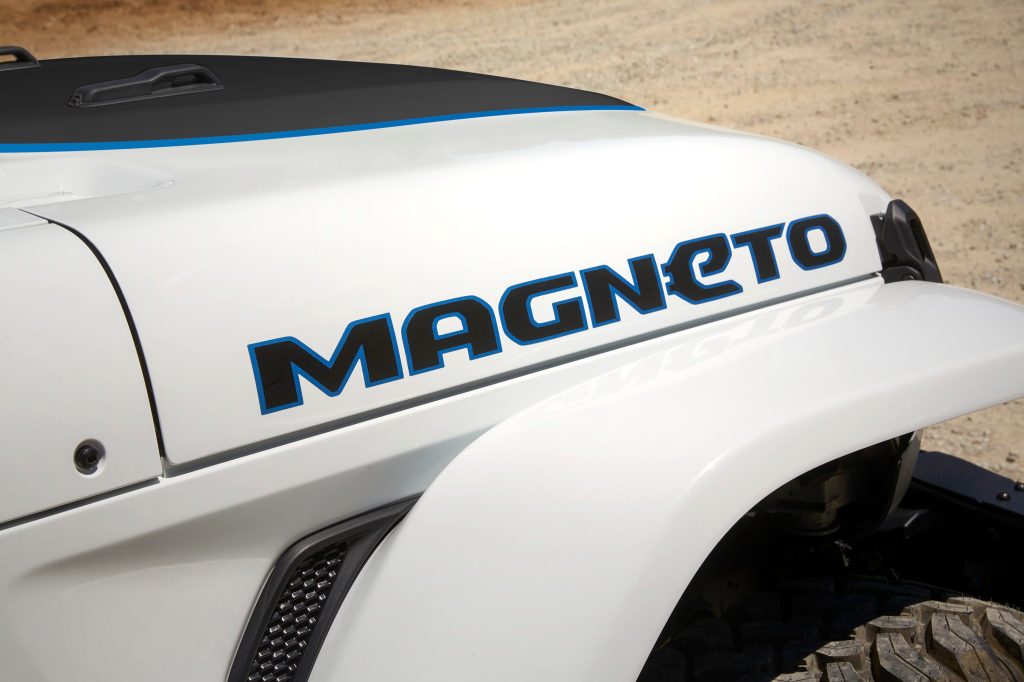
The exterior of the Magneto features a Bright White color with Surf Blue accents, along with a heavy-duty performance hood with center scoop and custom decal, redesigned rear gate and dramatic full-width forward lighting. Custom Royal Blue and Black leather seats with Sapphire-colored inserts and straps, Surf Blue truck bed liner and Mopar slush mats give the Magneto’s interior design an electrified appearance.
 
The Jeep Magneto comes equipped with a JPP 2-inch lift kit, 17-inch Lights Out black metallic wheels with 35-inch mud-terrain tires, custom roll cage, Mopar Rock Rails, steel bumpers with a Warn winch and a steel belly pan for added off-road capability. “


ICYMI: The Modern Mustang SVO Looks Rad on Rally Wheels

Peak ’80s geek-chic down to its four-eyed grin, the 1984 Ford Mustang SVO rocked a 2.3-liter turbo, a bi-plane spoiler and instantly identifiable full-face machined wheels. The rebirth of a turbo-four Mustang 31 years later was a spiritual resurrection, right down to the fabled 2.3-liter displacement. With a standard six-speed manual and an expressive color palette framed by hues of green, blue and orange, the 310-horsepower Mustang EcoBoost is a compelling package that needs just one dash of spice to bring the SVO aesthetic back to life: a decent set of wheels.

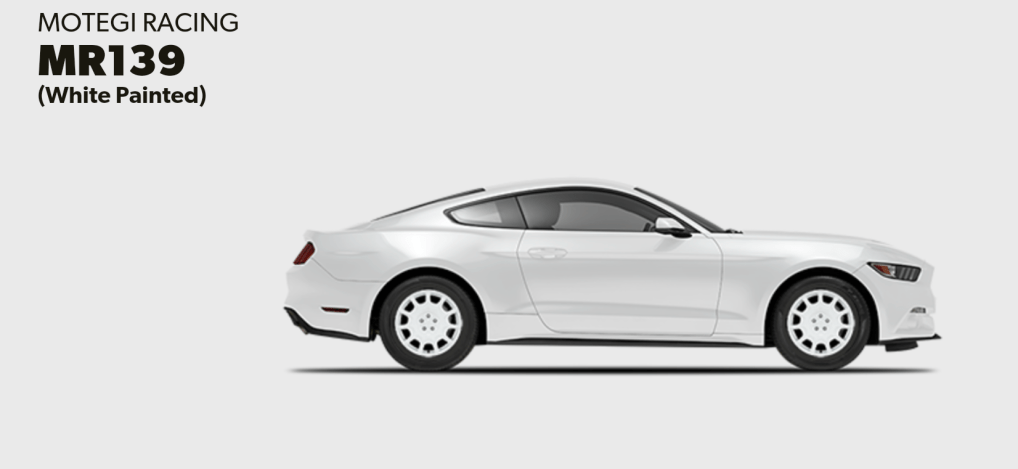
The base Mustang’s standard-issue silver flangeless five-spoke wheels are par for the segment, with a conventional (read: forgettable) design. But as Tire Rack’s configurator shows, $650 buys a set of bright white Motegi Racing MR139 rally wheels that makes the entire chassis pop, transforming the modern Mustang’s silhouette into a Group A rally homologation special.

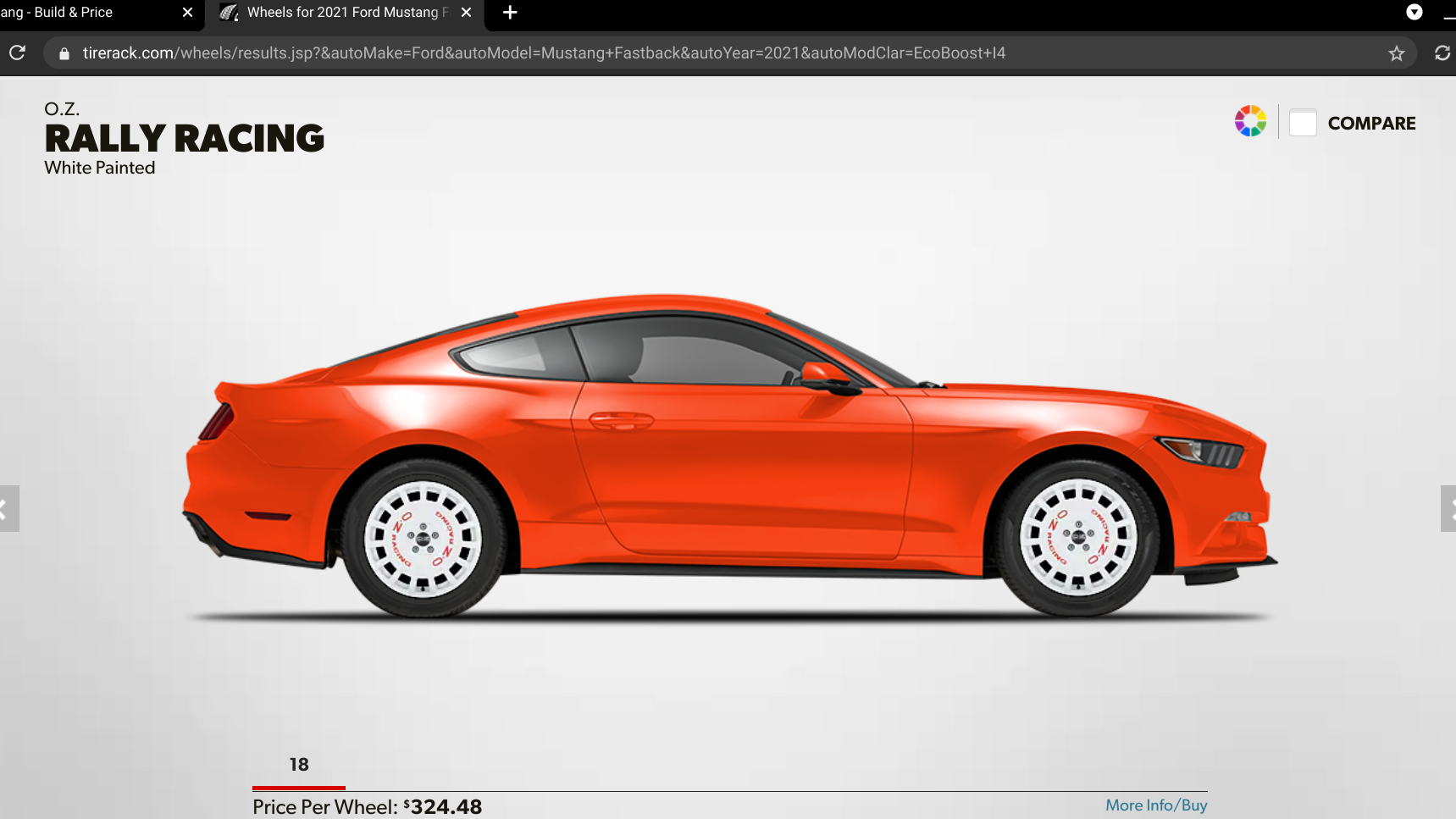
Twister Orange paint turns the most-base Mustang into an icon in its own right, recalling the red-orange hue of the final Fox Body Cobra. Double your budget, and you can inch-up to a $1300 set of 18×8 O.Z. Rally Racing wheels with red lettering that complements the effect.

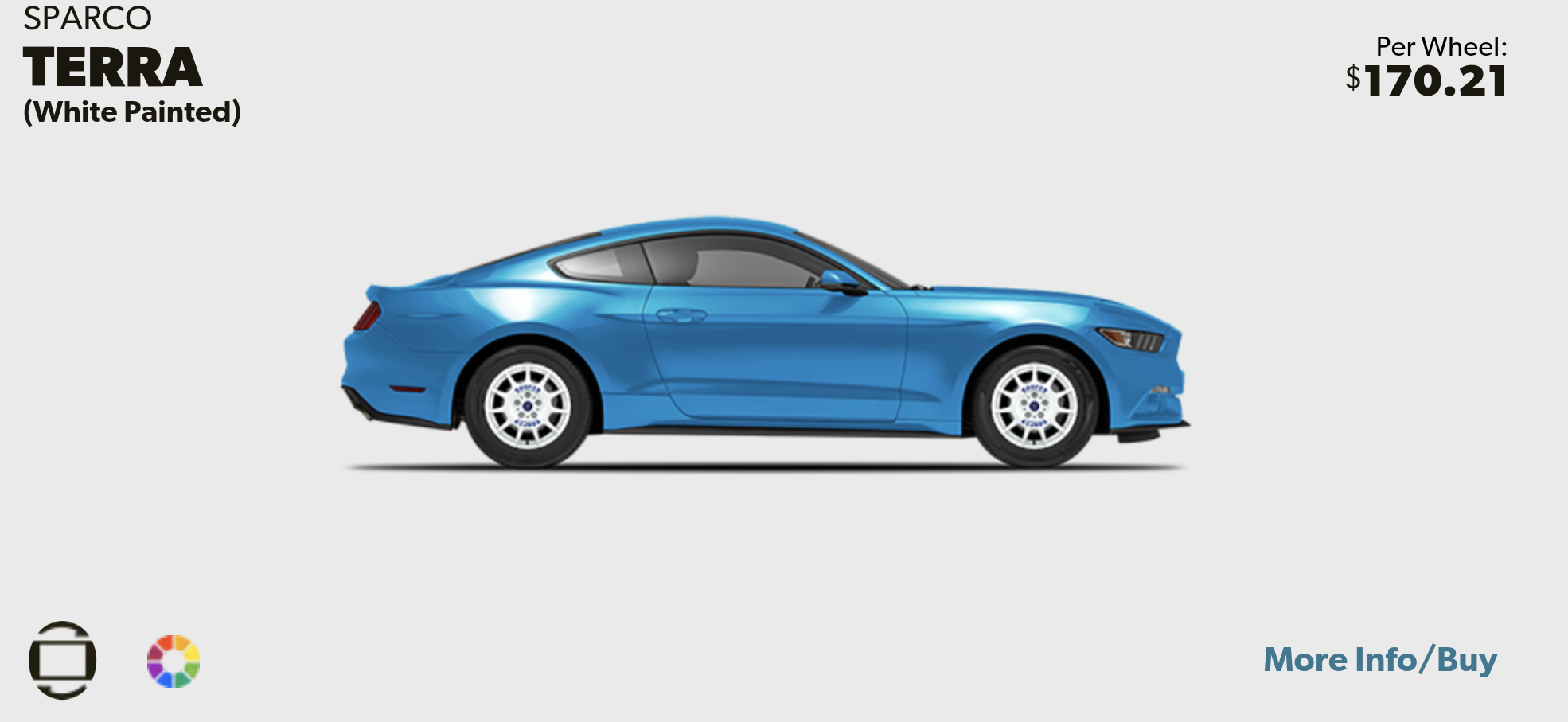
Sparco’s wheels are manufactured by O.Z., marking a low-cost way to equip Italian rally cred. The $680 set of 17-inch Sparco Terra wheels comes with a blue sticker kit that seems to hold up well during daily use, if Instagram is to be trusted. The Sparco logo color-keys well with Ford’s Velocity Blue paint — it’s not the look you’d expect to see on a Mustang, and that’s absolutely the point.

Be warned: Tire Rack’s mobile-friendly configurator is a super-fun timesuck, allowing you to thumb through your car’s OE color palette and try on different kicks. White wheels look good on everything, but there’s something forbidden and delicious about seasoning America’s performance icon with European flavor — an effect that still works three decades after the Mustang SVO gave us the idea.

@highmileage is a world-traveling automotive historian. follow adam barrera on instagram.

Six Ways to Love the Six-Speed Manual Cadillac V-Series Blackwing

At the V-Series Blackwing reveal last night, Cadillac’s fastest pairing shed their race-inspired camouflage and showed their true lines to the world. After an evening of reflection, six particular endearments set up the CT4-V and CT5-V for the perfect launch.

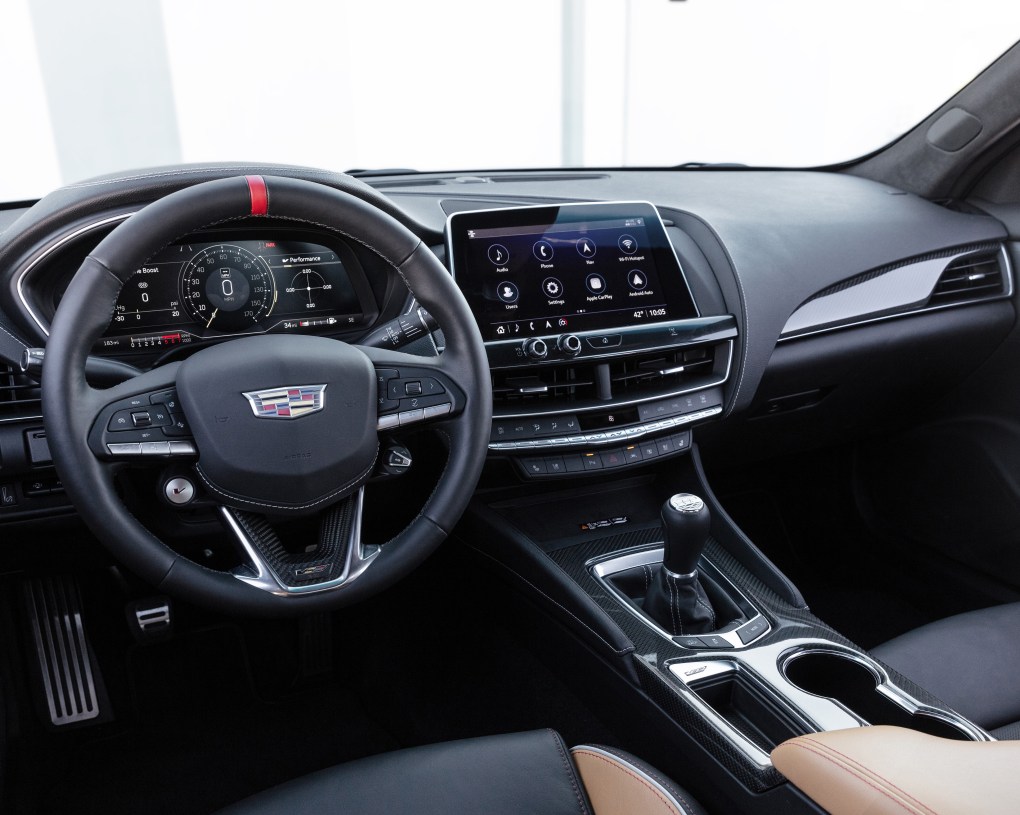
A five-digit serialized VIN plate represents the model (8 = CT5-V Blackwing), the transmission (6 = manual transmission) and the number vehicle built (001 = first vehicle built).

The first manuals will be auctioned off for charity.

Though early adopters can reserve one of the first 250 cars with a refundable $1000 deposit, GM is saving the very first manual VINs for a higher cause. The reservation site states that “GM intends to auction the first manual transmission VINs for the CT4-V Blackwing and CT5-V Blackwing and donate the proceeds to a worthy cause.” Keep an eye on the high-profile auctions this summer, just in case.

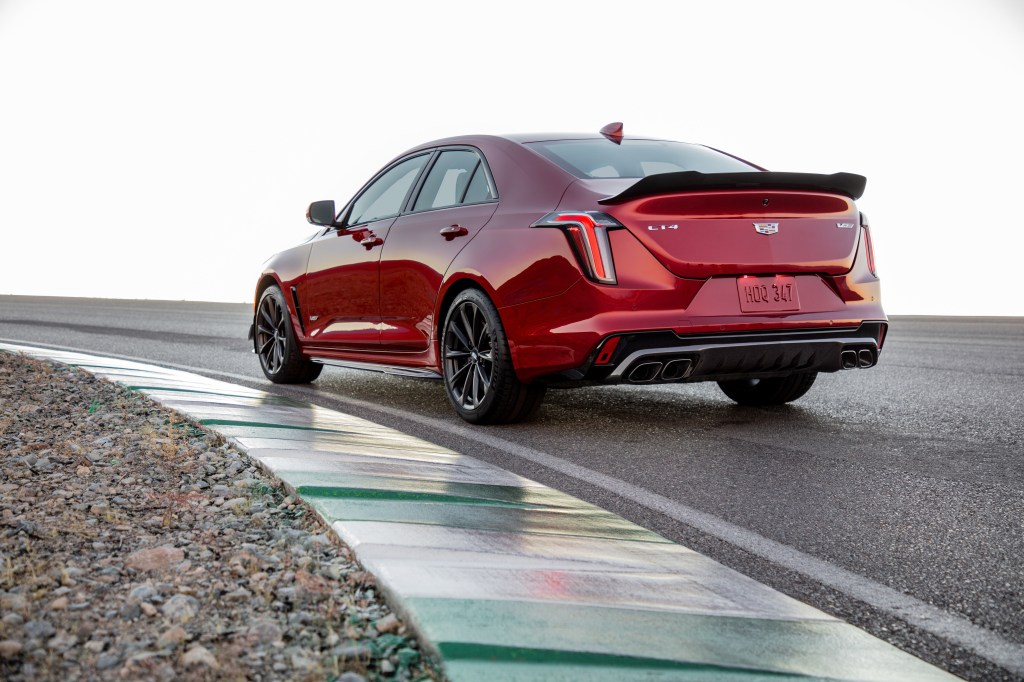
668 horsepower. In a sedan.

Not a crossover. Not a truck. As Cadillac makes the necessary transformation to an electric vehicle brand, the Blackwing is a 200-mph last hurrah for both petrol-powered motive and the classic sedan silhouette.

Screaming supercharger or turbo spool?

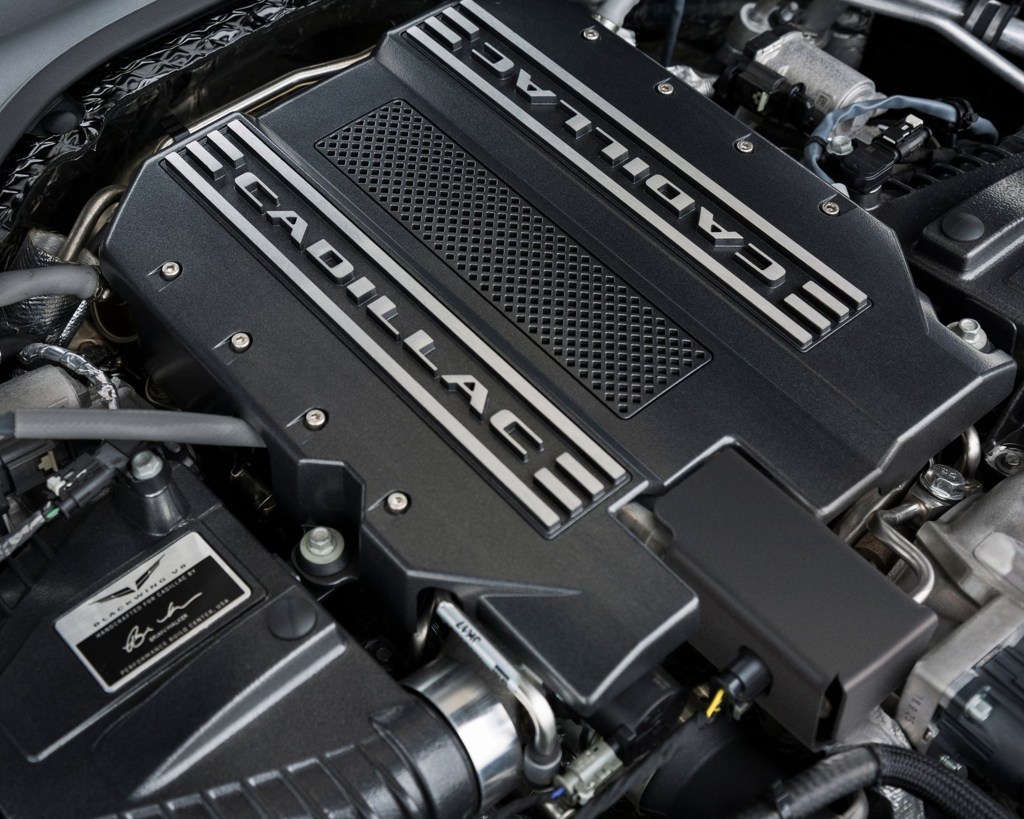
You pick. Big brother CT5-V sports the classic supercharger whine pioneered by the CTS-V, while the new-school CT4-V relies on sophisticated twin-turbos and a compact V6 engine architecture. Both are bound to provide visceral engagement through two distinct formulas of sound and feel.

AKG audio always bumps.

We haven’t had a chance to sit in the CT4-V Blackwing yet, but we’ve had a lot of experience with Harman premium audio systems in the past. Harman’s bespoke systems are fine-tuned by career audiologists in Farmington, Michigan, and the end quality is always amazing. AKG earbuds are some of our favorites, so we’re interested to spin our Detroit playlist in the Blackwing series when they hit the street.

Easter eggs will keep this car fresh for years.

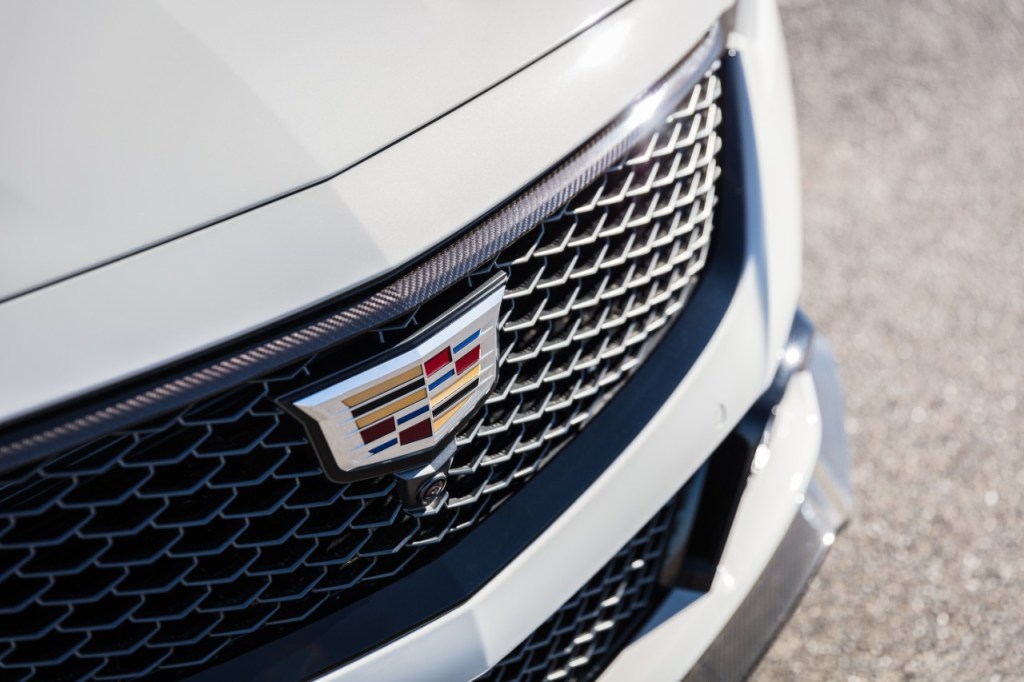
Cadillac designers refer to their iconic intersecting rectangle livery as “the Mondrian pattern”, named after the famed Dutch painter who used stark black lines to divide panels of color. Cadillac’s interpretation can be found throughout the car, from the 3D-printed shift knob trim to the car’s aero-sculpted undertray. Designers teased in the launch video that they hid nods to Cadillac history throughout the vehicle, and owners will likely continue to discover these secret surprises years down the road.

The price.

German supersedans, none of which can be fitted with a manual in the US now, tend to look dated as soon as the newest successor debuts. But the Cadillac CTS-V series has aged more than gracefully, with the final CTS-V wagon still attracting admiration some six years after the end of production. Fast Cadillacs have a staying power that the German brands just don’t, and with a starting price tens of thousands of dollars below the competition, the Blackwing series represents a victory for car culture at large — especially with a standard six-speed manual transmission.

@highmileage is a world-traveling automotive historian. follow adam barrera on instagram.