Ask the Owners: Is the Elantra N Worth Losing the Veloster?

Multiple outlets such as carsdirect.com have reported since April that Hyundai would be offering fewer trims of the Veloster after 2021. A few weeks ago, Hyundai confirmed that all versions of the Veloster would be discontinued except for the track-ready 275-horsepower Veloster N. Although we may not like this change, we can’t argue that it doesn’t make financial sense, since Veloster sales have been in decline for several years. In 2019, Hyundai sold 12,849 Velosters, while only mustering to move 7,581 more in 2020. Both numbers are a sharp decline from the Veloster’s best sales year, when Hyundai sold 38,102 copies of the 2012 model.

Losing the base Veloster is certainly a blow to the manual shifting crowd here at TMGPS. The Veloster offered a manual transmission with every engine and every trim. The base Veloster moves with a six-speed mated to a 2.0-liter naturally aspirated four-cylinder engine producing a respectable 147 horsepower. It won’t win any races, but it reaches highway speeds at a respectable pace. The six-speed Veloster Turbo R-Spec steps up to a 1.6-liter turbocharged GDI four-cylinder producing 201 horsepower. Before the Veloster N was introduced, the Veloster Turbo was the hottest version of the car. This is a sweet spot for most buyers; at $23,450, it’s one of the cheapest ways to get into a 200+ horsepower car. At the top of the range lies the Veloster N, with a six-speed manual transmission mated to a 275-horsepower 2.0 liter turbo GDI four-cylinder. At $32,250, the Veloster N is track-prepped to compete against the likes of the Honda Civic Type R and the Volkswagen Golf R. (To read about the 2022 Honda Civic Type R, click here.)

Due to limited sales in only one trim level, it isn’t a stretch to guess that the Veloster N may be discontinued after 2022. Owners in the TMGPS.org Member Group on Facebook swiftly reacted to the news.

“I own a first-gen Veloster Turbo M/T Tech, and while I’m a bit sad to see the line being discontinued, it also seems like it’s for the best,” said TMGPS.org member Justin Cook, who feels the second-gen Veloster lost some of the first car’s charm. “The first-gen, while falling short of the original concept’s glory, still retained many of the styling cues and much of the unique, quirky spirit of the concept. The quirky uniqueness of the three-door layout — “two on the safe side” as Hyundai billed it — brilliant. The heated seats by Recaro, with heating elements that actually run up the back of the seat, are well above their class, and absolutely outstanding… I bloody love my seats.”

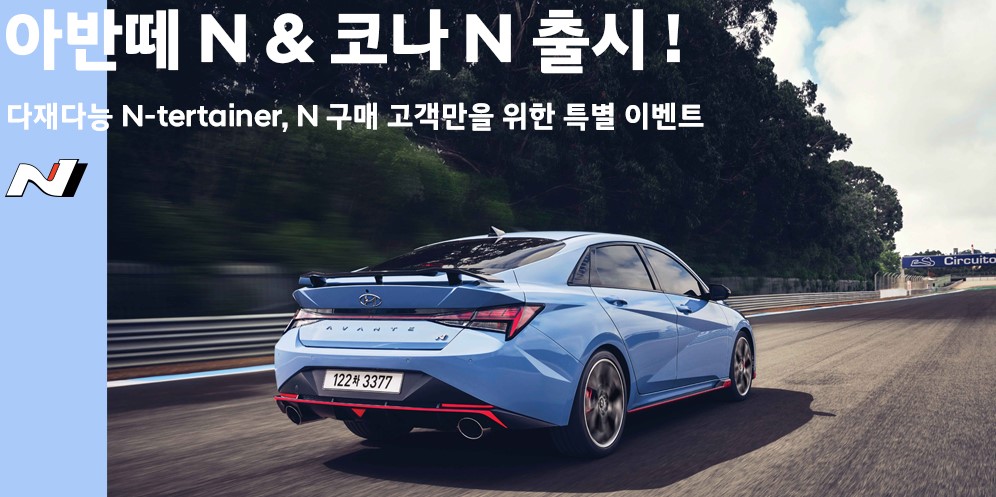
Though the Veloster might disappear into history, for manual-shifting Hyundai fans, the future isn’t all bleak. For several months, Hyundai has teased the Elantra N, which will feature the same six-speed and 275-horsepower turbocharged 2.0 liter engine from the Veloster N. Set to bow in 2022, the Elantra N will be sold alongside the Veloster N for at least that year. While both the Elantra and Veloster look like they could be based on the same chassis, they are in fact distinct: The Elantra has a slightly longer wheelbase, and is 15 inches longer overall. The longer wheelbase might seem like a detriment, but by gaining two full sized rear doors, owners are more likely to haul passengers than with the Veloster’s smaller third door — making it a more practical choice for families and expanding its sales potential.

The 2022 Hyundai Elantra N should start around $35,000, marking a $3000 premium over the Veloster N, but still $4000 cheaper than the Civic Type R and nearly ten grand less than the Golf R.

Miles Wenzel is a manual enthusiast with a love for the great outdoors. Follow #DriveYourCars, a video guide for DIYers who wrench to drive and drive to live.
The Stickshift Prevails in the Next Civic Si and Type R

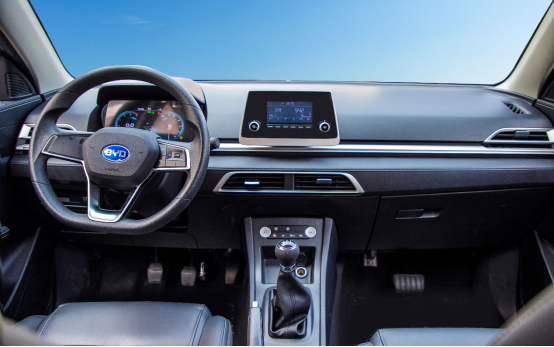
In an interview with CivicXI.com last week that you can see here, Honda Media Relations Manager Carl Pulley revealed that the manual transmission will live on in the next generation of the Honda Civic. Pulley confirmed that both the Civic Si and the Civic Type R will exclusively feature Honda’s legendary manual gearbox. Pulley also said that while the manual transmission will no longer be available in the sedan, buyers will still have the option to check the box for a manual in the five-door hatchback.

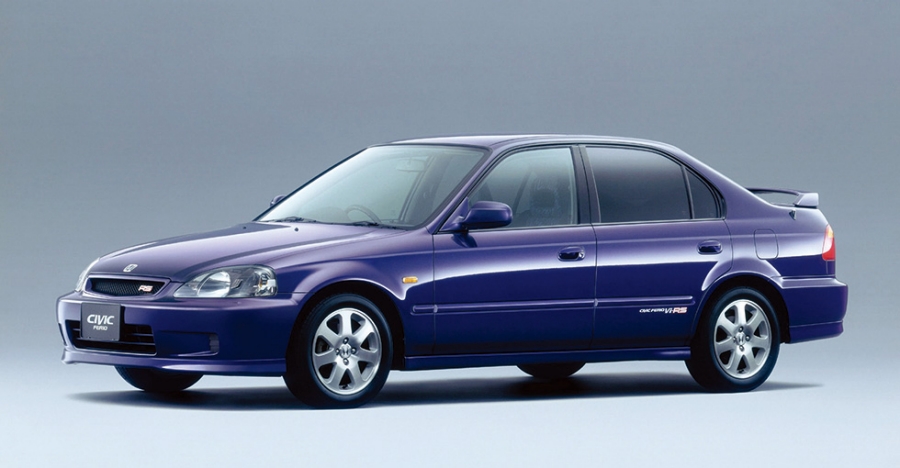
We here at TMGPS are obviously excited that Honda is continuing with its tradition in offering their performance line of Civics with no other option than a stick shift. Starting with the third generation of Civics, the Si variant hit the U.S. shores in November of 1984 with five-speeds commanding 91 horsepower from a 1.5 liter 12-valve SOHC engine. VTEC was introduced to the U.S. spec Sis in 1992 with the fifth generation Civic, again with five speeds and an increase of power to 125 horsepower from a 1.6-liter engine. The legendary 1999 Civic Si was and still is the Civic that most of us remember from our youth. The B16 VTEC 1.6 liter 4 cylinder sporting a 8200 RPM redline brought 160 horsepower to the five-speed manual. Iconic Electron Blue Pearl paint made for one of the most coveted front-drive performance cars of all time.

While Japan has enjoyed Type R variants of Hondas for decades, America only recently began to enjoy performance-focused Civic Type R in 2017. Whereas the Civic Si historically sports more luxurious amenities like a moonroof and a modest power increase over a regular Civic, the Type R in recent years has bet big on horsepower and suspension tweaks. The current Civic Si’s 205 horsepower is respectable; however, the Type R’s 306 horsepower makes it debatably one of the best front-drive track attack machines. The Civic Si features a snappy six-speed manual. The Civic Type R once again shows its racing roots, offering a shorter throw gear selector and automated rev matching for both upshifts and downshifts.

As of now, Honda has not released power numbers for the eleventh-generation Civic Si or Type R. Whether power numbers increase or stay put, it’s not too early to say that these two performance models will be Honda’s best efforts in the Civic range to date.


Simulated Manual Transmissions For Driver Training

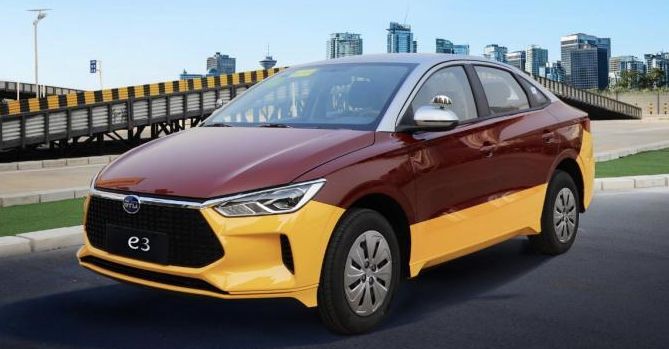
BYD E3 Driving School Package with clutch, shifter, and passenger side brake pedal.

Chinese Automaker BYD has recently developed a simulated manual transmission for electric vehicles specifically for driver training. I had overlooked this news initially, assuming it was no different from the BEV manual concepts we’ve commented on in the past. I failed to recognize that this was the first exclusively electric vehicle to add a manual transmission and that the inputs and feedback from the system are entirely simulated.

Unlike some of the other examples of manual transmissions in electric cars, where the electric motors output shaft is mated with a conventional clutch and manual gearbox, The BYD E3 clutch and shifter send instructions to the controller which presumably manipulates the speed and torque characteristics of the output in a way which mimics the dynamics of a gear change. I would also expect some sort of feedback in the clutch to simulate the feeling of a bite point. Chery had also developed a similar system for the same purpose with the eQ2, but in this case the vehicle had started as an ICE product that already offered a manual transmission, so the required parts were already existing and integrated.

As China’s massive growth of the middle class matures, its relatively new automotive industry and market are budding rapidly. It’s interesting to observe this from the context of our Western automotive landscape, where we collectively have a lot more direct experience with what some might soon be considered archaic technology. Without several decades of amassed used car inventory to satisfy growing waves of new drivers, the low-cost first-time buyers’ car in China is more likely to be a mini EV than a used Volkswagen. China’s undeniable pollution issues and their government’s ability to control and regulate the marketplace will presumably continue to push things in this direction quite forcefully.

With that backdrop, it is somewhat surprising to learn that there is adequate desire to acquire the skill of driving a manual transmission for two manufacturers to develop and produce simulated manual transmissions on electric cars specifically for the use of driver training. I assume that the primary motivation for acquiring the skill is for occupational purposes. It would be fascinating to find out if there is some level of enthusiasm among new drivers to think about driving more joyfully or recreationally. It’s hard to imagine this technology as a desirable feature outside training or finding its way to our shores. Still, as a driving enthusiast and manual fanatic, I’m glad it exists.


Could a Widebody AWD GR Corolla Hit Toyota Showrooms Soon?

Rumors of a fire-breathing, manual transmission, all-wheel-drive Toyota GR Corolla Hatchback were reported by Car Sensor in Japan last week, brought stateside by James Gilboy at The Drive. Could we soon see a 297-horsepower turbocharged three-cylinder under the hood of the sporty-looking but mild-mannered Corolla on U.S. shores?

Rumor holds the GR Corolla could crib its engine, transmission and all-wheel-drive system from the internationally heralded GR Yaris. A highly capable Corolla being offered stateside might dull the pain of being snubbed from having the GR Yaris available to us, especially if the car receives a slight power bump over the Yaris as forecasted by Car Sensor.

The 306-horsepower Honda Civic Type R outmuscles the current GR’s powertrain. However, the front-drive Civic may be at a disadvantage when it comes to which wheels lay down power. Honda’s heritage lies in fast front-drive compacts; the GR Corolla pulls a page from Toyota’s all-wheel-drive history instead, reaching back to the sixth-generation E90 Corolla All-Trac. Car Sensor goes a step further to validate that historical connection, reporting that a separate GR Corolla Wagon is a distinct possibility, perhaps even with a hybrid system coupled to a slightly larger-displacement engine.

Let’s assume the GR Corolla Hatchback would share the same selectable drive modes available in the GR Yaris. The GR Yaris has an “advanced driving force system” utilizing an electronically controlled multi-plate clutch, which provides a certain amount of torque to the front and rear wheels based on the drive mode selected. In the normal driving setting, the engine’s torque is split conservatively with 60% in the front, and 40% in the rear. Once the selector is switched to sports mode, the GR Yaris switches to an aggressive 30% front, 70% rear split. Track mode divides the torque evenly with a 50/50 split. Torsen provides limited slip differentials in both the front and back of the GR Yaris, making the car ready for track events from rallycross to autocross.

TMGPS member Nathan Geer shared his thoughts on the GR Corolla’s potential: “I can’t wait for Toyota to release the details,” said Geer, the owner of a 2019 Corolla Hatchback finished in Blue Flame. “It should be the car that finally puts Toyota in the STi and Golf R playing field.”

Miles Wenzel is a manual enthusiast with a love for the great outdoors. Follow #DriveYourCars, a video guide for DIYers who wrench to drive and drive to live.

1 in 6 Ford Bronco Buyers Pick the Manual Transmission

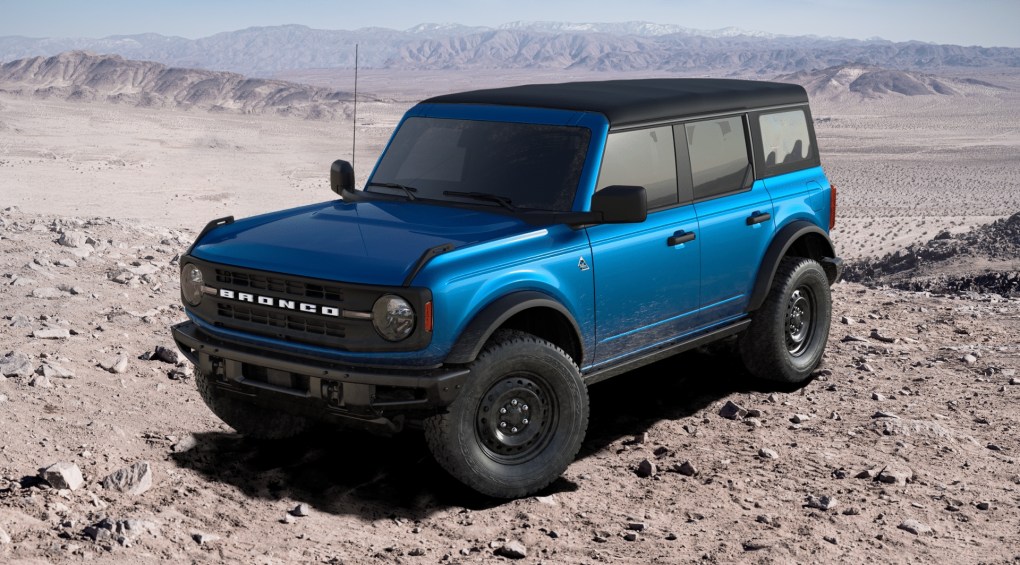
The Ford Bronco is quickly becoming a symbol of hope for stick shift enthusiasts. Out of 125,000 pre-orders, 22,500 will be delivered with a row-your-own box — an 18 percent take-rate for the seven-speed manual transmission.

Only the base 270-horsepower 2.3-liter turbocharged four cylinder engine can be paired with the manual transmission. While some may be disappointed the more powerful 310-horsepower 2.7L twin-turbo V6 isn’t available with a manual, it’s important to note that the turbo four is still more powerful than any available engine in any previous-generation Bronco.

The new Getrag 7MTI550 manual transmission operates like a normal six-speed during daily driving. The additional seventh speed is a dedicated off-road crawl gear, marked with a “C”, placed just below reverse on the left side. Crawl is an extremely low 6.588:1 ratio — for comparison, the Jeep Wrangler low gear is 5.13:1. The crawl gear is especially useful on steep rocky terrain and in vehicle recovery operations. To put it another way, the crawl gear will help you be the hero of the day as you pull a buddy’s Jeep out of a deep mud hole.

On the manual transmission Black Diamond trim, buyers are offered two different transfer case options. The standard part-time two-speed transfer case has three selectable drive modes: Two-Wheel High, Four-Wheel High and Four-Wheel Low.  The optional Advanced 4×4 Automatic On-Demand Engagement transfer case adds a fourth drive mode called 4A, which continuously adjusts power to the front wheels based on current driving conditions. As in other Ford systems, 4A keeps the Bronco in rear-drive until slip is detected. Once slip occurs, a proportional amount of torque is sent to the front wheels to keep control. In my personal experience, I have found this mode quite useful on wet pavement in other Ford vehicles.

Also exclusive to manual Broncos are Hill Descent Control and Crank in Gear. Hill Descent Control utilizes anti-lock braking and traction control to manage wheel spin and maintain a constant speed while traveling downhill. Crank in Gear enables the driver to start the engine while in gear in order to execute more advanced off-road maneuvers such as a hill recovery technique.

There are so many different Bronco combinations that the only easy choice is picking the transmission. I would option my four-door Bronco Black Diamond in Velocity Blue with the seven-speed, steel wheels and the standard transfer case for the sake of tradition.

If the global microchip shortage does not hinder production, delivery of reserved Broncos is expected to start in June 2021.  

Miles Wenzel is a manual enthusiast with a love for the great outdoors. Follow #DriveYourCars, a video guide for DIYers who wrench to drive and drive to live.

JEEP MAGNETO TESTS AN OPTIMISTIC TMGPS THEORY

It feels like a lifetime ago that I was in Vegas chatting with Mark Allen, Jeep’s design shepherd (and my former boss), over some rye whiskey about the plausibility of an electric Wrangler which utilized traditional gearing and axles. It had been on my mind as the topic of manuals on electric cars comes up pretty frequently at TMGPS, and we had just seen the Ford/Webasto Mustang collaboration debut earlier that day at SEMA. Like most of my conversations with Mark, it was somewhat nerve-racking; either he’d dismiss the idea with stinging disapproval or he’d dismiss the idea with a mischievous grin, make a sarcastic joke, and change the subject. To my delight, and most likely thanks to the Manhattans, he was unusually receptive to the conversation. He told us about a friend of his who had built something along those lines and that it had worked fine. “You can start in 1st or you can start it in 4th, doesn’t matter! You don’t need the gears, but they’re there if you feel like going through them…” he said. I asked if there was any benefit to having the low range gearing when it came to crawling with a hypothetical electric Jeep. To which he responded with a shrug, and then changed the subject. I turned to my old pal Chris Piscitelli who had been responsible for the Moab Easter Jeep Safari builds for the past several years and asked what he thought about doing a build. “They don’t really let us do manuals anymore. A lot of the journalists don’t know how to drive them… besides, they’re moving me to Dodge when I get back.” EJS got canceled due to Covid-19 about six months after that conversation.

Many electric car experts will be quick to point out the on-demand torque of a BEV as a means for shedding the weight and complexity of a multi-ratio gearbox. As someone who loves driving manuals, but is also very interested in electric cars, the ultra-low ratios found in something like a Jeep Wrangler has always seemed like a great opportunity to experiment with the idea of slowing down typically high-RPM electric power with more traditional drivelines. The fact that Wrangler is also required to operate at highway speeds, and has limited space for batteries, means that there could also be a benefit to using the higher-end ratios to eke out some extra wheel speed from a motor that is turning at a lower RPM and potentially using less of the stored energy.

I was thrilled last night when I found out that the Jeep Magneto concept would in fact mate an electric motor to the stock JL 6-speed manual and drivelines! I have to say I’m a little salty we didn’t get a heads-up, and a chance to slap a TMGPS decal on it, but hopefully they’ll make it up to me with a chance to drive it one day. Until then, I can’t wait to find out how it does out on the trail and whether or not it’s an idea that makes sense for future production products.

Rather than crafting a homestyle copy pasta of the press release, I’m going to just let the fine folks at Jeep describe it in exactly the way they penned it.

“The Jeep Wrangler Magneto concept is a fully capable BEV that is stealthy, quiet, quick and an unmistakable rock-climbing force. Jeep brand engineers and designers have created a zero-emission vehicle with Jeep 4×4 capability that provides new levels of efficiency, environmental responsibility, and performance on- and off-road.
 
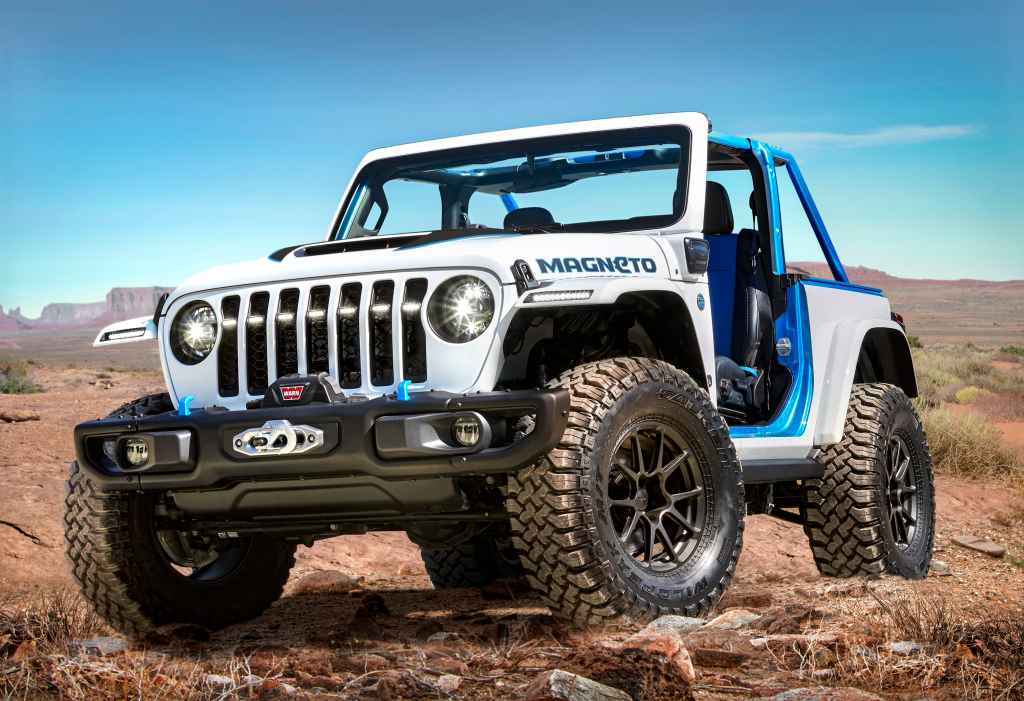
Based on a two-door 2020 Jeep Wrangler Rubicon, the Jeep Magneto uses a custom-built axial flux electric motor that operates up to 6,000 rpm. The e-motor is connected to a six-speed manual transmission, creating a unique manual-electric powertrain with a clutch that operates as it would with an internal combustion engine. In quick-shift scenarios, the e-motor engages regen upon clutch engagement to prevent rev-hang.
 
Comparable to the 3.6-liter Pentastar V-6, the compact e-motor is tuned to deliver up to 273 lb.-ft. of torque and 285 horsepower. Intentional calibrations developed during testing help the Magneto’s powertrain emulate the driving experience of the V-6, matching not only torque but also horsepower. During moderate driving, the performance difference between the V-6 and the Magneto’s unique manual-electric powertrain is negligible except for near-silent operation.
 
When greater acceleration is needed, the e-motor delivers all 273 lb.-ft. of torque without the need to build up revolutions per minute. The Magneto concept runs 0-60 mph in 6.8 seconds.
 
Powering the Jeep Magneto’s e-motor are four battery packs with a combined power of 70 kW/h, running an 800-volt system. The lithium-ion batteries are distributed around the Wrangler to balance weight on the four wheels. One pack replaces the Wrangler’s mid-ship fuel tank, another is mounted opposite the fuel tank location, the third pack sits atop the e-motor under the hood and the fourth pack mounts in the space normally used for a rear storage compartment, also using space typically occupied by the exhaust muffler.
 
An inverter derived from race cars converts DC power to AC for the high-tech motor. The batteries, a vehicle interface box and the battery control module all reside in waterproof enclosures to maintain the Wrangler’s 30-inch water-traversing capability. A 12-volt battery powers existing systems, such as the radio and lighting. A second 12-volt battery serves as an auxiliary power unit (APU) for accessories, such as the winch. A DC-to-DC converter charges both 12-volt batteries, allowing long-term operation of accessories to power a campsite or an unexpectedly long winch operation. Unique mounts secure the battery packs for harsh driving and custom skid plates protect the packs from potential strikes to the undercarriage while traversing harsh terrain.
 
A 10-kw high-voltage heater keeps the fully open-air passenger compartment comfortable.
 
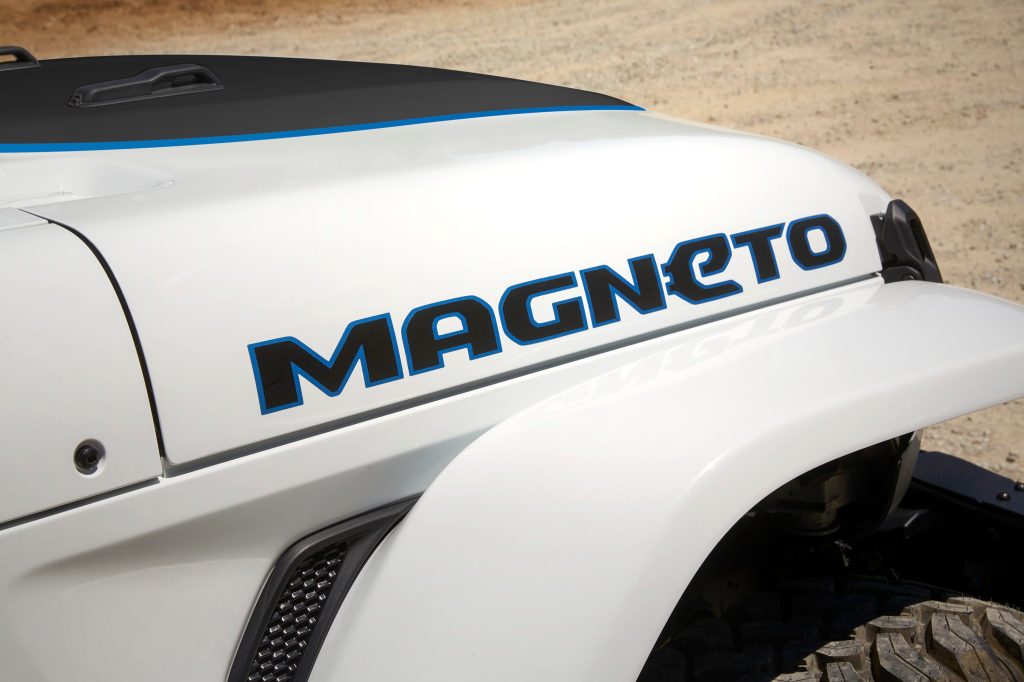
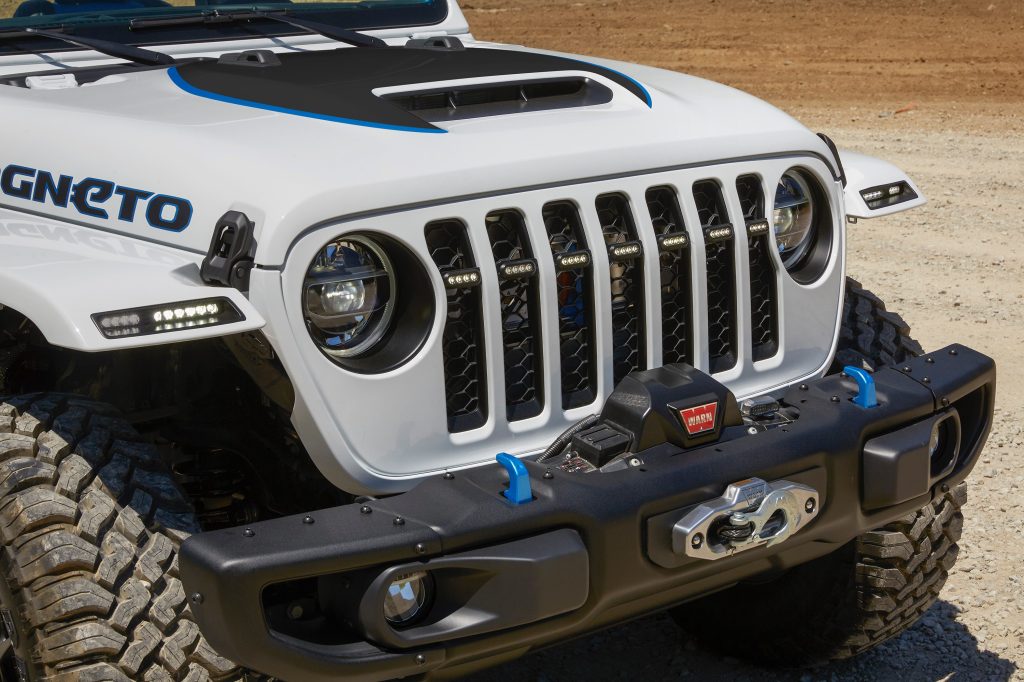
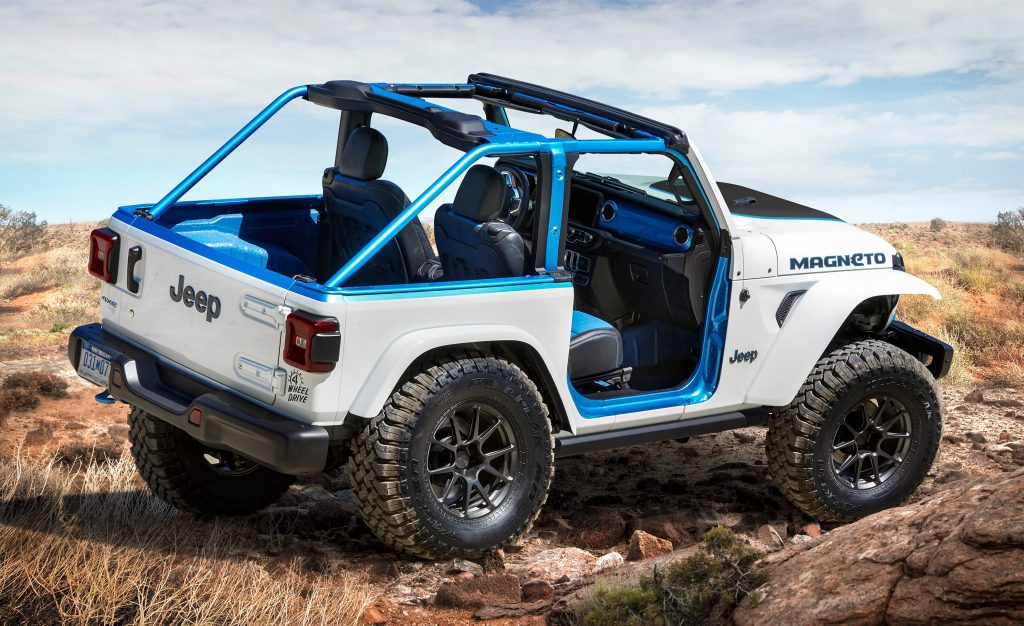
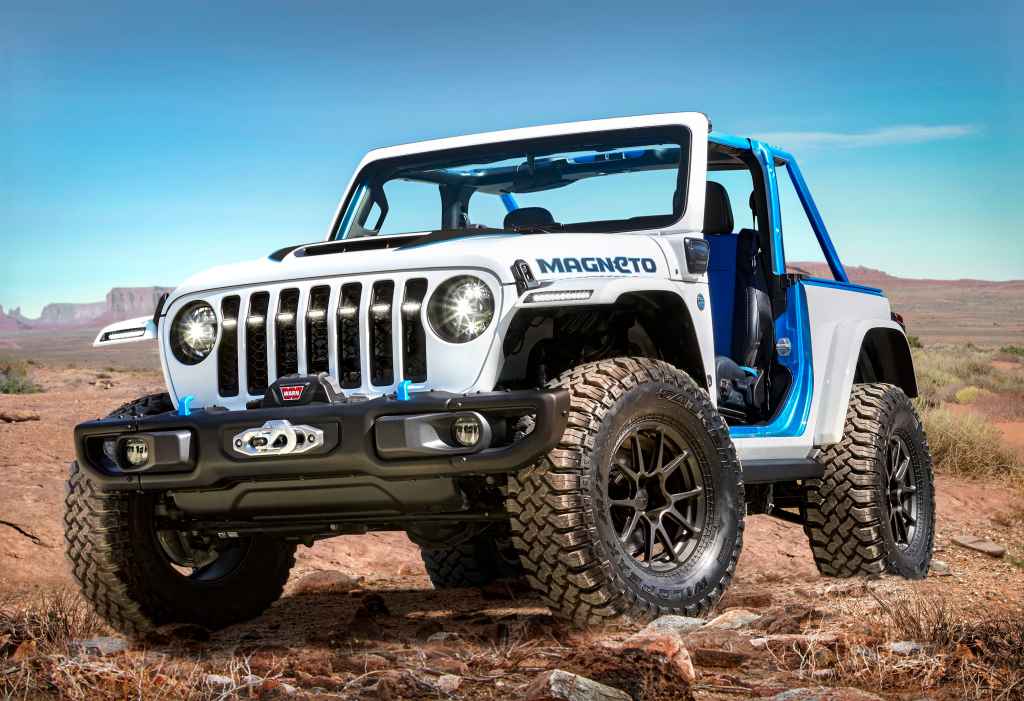
The exterior of the Magneto features a Bright White color with Surf Blue accents, along with a heavy-duty performance hood with center scoop and custom decal, redesigned rear gate and dramatic full-width forward lighting. Custom Royal Blue and Black leather seats with Sapphire-colored inserts and straps, Surf Blue truck bed liner and Mopar slush mats give the Magneto’s interior design an electrified appearance.
 
The Jeep Magneto comes equipped with a JPP 2-inch lift kit, 17-inch Lights Out black metallic wheels with 35-inch mud-terrain tires, custom roll cage, Mopar Rock Rails, steel bumpers with a Warn winch and a steel belly pan for added off-road capability. “


Watch Live: Cadillac V-Series Blackwing Reveal

Cadillac surprised the blogosphere in January by revealing that the upcoming race-bred CT5-V can be optioned with a third pedal. Now, the American luxury icon is revealing the rest of the story behind the CT4-V and CT5-V in a livestreamed introduction every manual transmission enthusiast must see.

Building a bona-fide muscle sedan and boldly equipping it with a real manual transmission makes a case for Cadillac’s uniqueness in a market saturated with crossovers pretending to be coupes. Though the brand is fast headed to an all-electric lineup, the V-Series Blackwing models give enthusiasts one last chance to enjoy the command of three pedals.

Sign up for the live reveal with one click by heading to Cadillac’s Twitter post, and show GM that manual transmission enthusiasts will show up when manufacturers show up for us!

@highmileage is a world-traveling automotive historian. follow adam barrera on instagram.