
First, a disclaimer: Your ride is your creation, and if you love an idea, you should run with it. That said, there’s a certain subtlety among vanity plates in Japan that reflects the quiet cleverness of the culture there — whereas American vanity plates all too often go for the painfully obvious model name. You’ve gone through the trouble of sourcing authentic JDM parts, or maybe even an actual right-hand-drive import. How do you pick a novelty plate that feels authentic? Here are some pointers we gathered while browsing our JDM vehicle importer friend Caylon’s must-see Instagram feed.
Real JDM plates don’t use letters.
Your bold American sensibilities may tempt you to go for the deadpan SILVIA plate, but you’d never see letters on an actual JDM number plate. Consider instead going for a meaningful number related to the car: the displacement, for instance, or the numeric portion of the chassis code. Think Easter Egg, not obvious billboard.
Palindromes are prized.
Browse the @downthedori feed, and you’ll notice a curious trend: numbers that read the same backward and forward are extremely popular among the Japanese tuner set. Repeating patterns such as “99 – 99” seem popular, too, but we rarely if ever see a sequence such as “12 – 34”.
Less is always more.
Among the most impactful plates in Japan are those containing placeholder dots. Low-series plate numbers are highly desirable no matter what country you’re from, and this uniquely Japanese approach is all too uncommon among replica tribute plates.
Japan uses the metric system.
If your clever plate idea incorporates a unit of measure, just remember: real Japanese people use PS, not HP. Plates that include “MPH” or “HP” might leave an actual Japanese observer with a stare as blank as this road-legal plate.
Repeat that for me.
No one ruins a Silvia quite like Mitsuoka. Did the owner love this car authentically or out of irony? The repeating plate is a tip-off that, whatever the case may be, this owner is more than enthusiastic to talk about his car.
Zeroes are a status symbol.
Could this be a real 993 GT2? If not, it’s a convincing copy of a million-dollar car. Either way, zero plates are a coveted status symbol among enthusiasts in Japan, usually presented as a pair of zeroes either leading or trailing another set of double-digits.
Parallels are popular.
Whether it’s II – II, II, I – I or just I, Japanese enthusiasts have a penchant for the linear look. Instead of a platform for advertisement or personal statements, Japanese number plates are often customized to a design aesthetic that creates a clean look.
Yes, chassis codes are okay.
If you’re lucky enough to own a car with an all-numeric chassis code, by all means, go for it. No one’s going to argue this approach on a Porsche.
To preserve owners’ privacy, Caylon edits elements of each license plate in an effort to allay any sensitivities. Though the individual plates might be altered, the overall gallery gives a good sense of the custom plate aesthetic in Japan.
With these essentials in mind, I finally created my own personalized JDM number plate to wear at car shows and Tail of the Dragon runs. Like the best custom plates, this one has a story. Decode the mystery behind the numbers when I debut the plate in 2022.
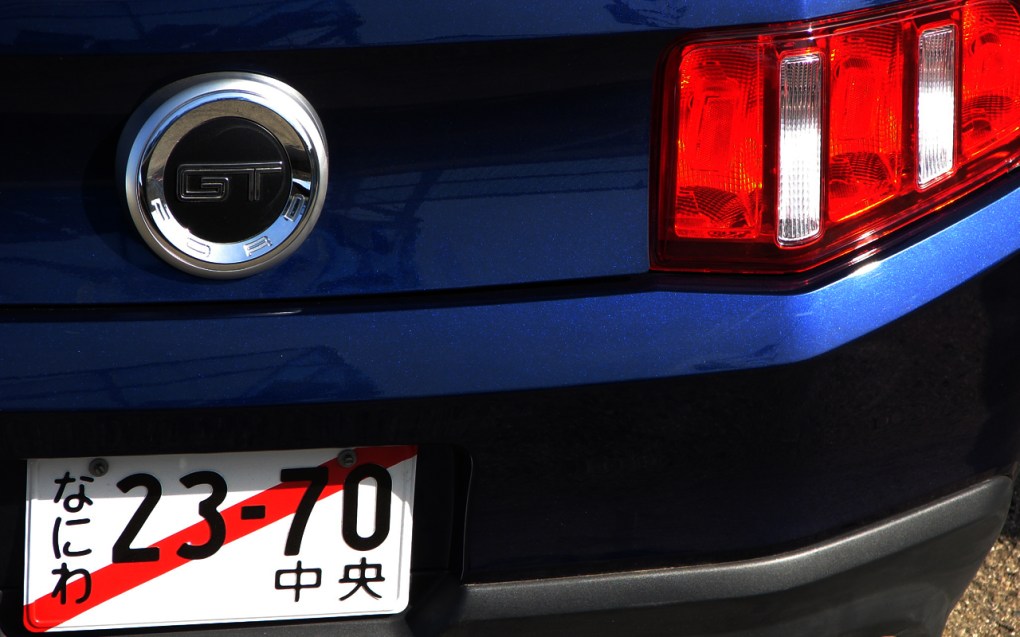
By the way: if you’re wondering about the title photo, let’s go back eleven years and remember the time I met Vaughn Gittin Jr. in Japan for a tour of the unreleased 2010 Mustang’s drift skills. Mustang Drifts Japan was a life-changing experience.
@highmileage is a world-traveling automotive historian. follow adam barrera on instagram.
 TMGPS JOURNAL