Next time you roll up on a new Corolla, don’t forget that it could very well be a stick. In fact, it could be Nathan Geer.
“I found out about the car back in 2019, when the great Larry Chen released his Corolla Hatch at SEMA,” said Geer, who remembered the tuner concept’s fifteen52 wheels above all. “I’m 18, so I was looking for a car that would be reliable enough to get me to school and work and still be fun enough for me to get excited to drive it everyday.”
Nathan knew the Corolla Hatch was a match. He also knew his would have to be a manual — even though he had never driven stick.
“I bought the car without knowing how to drive manual, so my dad drove it home from the dealership,” said Geer, a mechanical engineering student in his freshman year who learned to drive manual transmission on his new car. “It truly made the driving experience raw.”
The E210-chassis Corolla is so new, aftermarket companies are still developing performance parts. Geer said the owner community is active and helpful; springs, intake and exhaust options are out there, but front lips and diffusers are the most popular mods. For now, the owner community is focused on aesthetics — and Geer’s Corolla had no problems attracting attention out of the box.
“I have always loved the color blue and was amazed by how Nitrous Blue looked on the Focus RS,” Geer said. “When the Hatch was released in Blue Flame, I knew that was the right color for me. The color definitely draws a lot of attention, especially mid-day when the sun hits it.”
Squint, and you’ll see more than a little DNA from Gazoo Racing’s hottest projects out of Europe and Japan. With bulging fenders and right-sized proportions, the Corolla Hatch is a convincing visual package missing just one finishing touch.
“I was looking for a cool-looking sticker that still gave a warning not to get all up on the car at stops,” said Geer, who discovered The Manual Gearbox Preservation Society through the Instagram Discover feed. “The simplistic design of the TMGPS decal was exactly what I was looking for.”
It feels like a lifetime ago that I was in Vegas chatting with Mark Allen, Jeep’s design shepherd (and my former boss), over some rye whiskey about the plausibility of an electric Wrangler which utilized traditional gearing and axles. It had been on my mind as the topic of manuals on electric cars comes up pretty frequently at TMGPS, and we had just seen the Ford/Webasto Mustang collaboration debut earlier that day at SEMA. Like most of my conversations with Mark, it was somewhat nerve-racking; either he’d dismiss the idea with stinging disapproval or he’d dismiss the idea with a mischievous grin, make a sarcastic joke, and change the subject. To my delight, and most likely thanks to the Manhattans, he was unusually receptive to the conversation. He told us about a friend of his who had built something along those lines and that it had worked fine. “You can start in 1st or you can start it in 4th, doesn’t matter! You don’t need the gears, but they’re there if you feel like going through them…” he said. I asked if there was any benefit to having the low range gearing when it came to crawling with a hypothetical electric Jeep. To which he responded with a shrug, and then changed the subject. I turned to my old pal Chris Piscitelli who had been responsible for the Moab Easter Jeep Safari builds for the past several years and asked what he thought about doing a build. “They don’t really let us do manuals anymore. A lot of the journalists don’t know how to drive them… besides, they’re moving me to Dodge when I get back.” EJS got canceled due to Covid-19 about six months after that conversation.
Many electric car experts will be quick to point out the on-demand torque of a BEV as a means for shedding the weight and complexity of a multi-ratio gearbox. As someone who loves driving manuals, but is also very interested in electric cars, the ultra-low ratios found in something like a Jeep Wrangler has always seemed like a great opportunity to experiment with the idea of slowing down typically high-RPM electric power with more traditional drivelines. The fact that Wrangler is also required to operate at highway speeds, and has limited space for batteries, means that there could also be a benefit to using the higher-end ratios to eke out some extra wheel speed from a motor that is turning at a lower RPM and potentially using less of the stored energy.
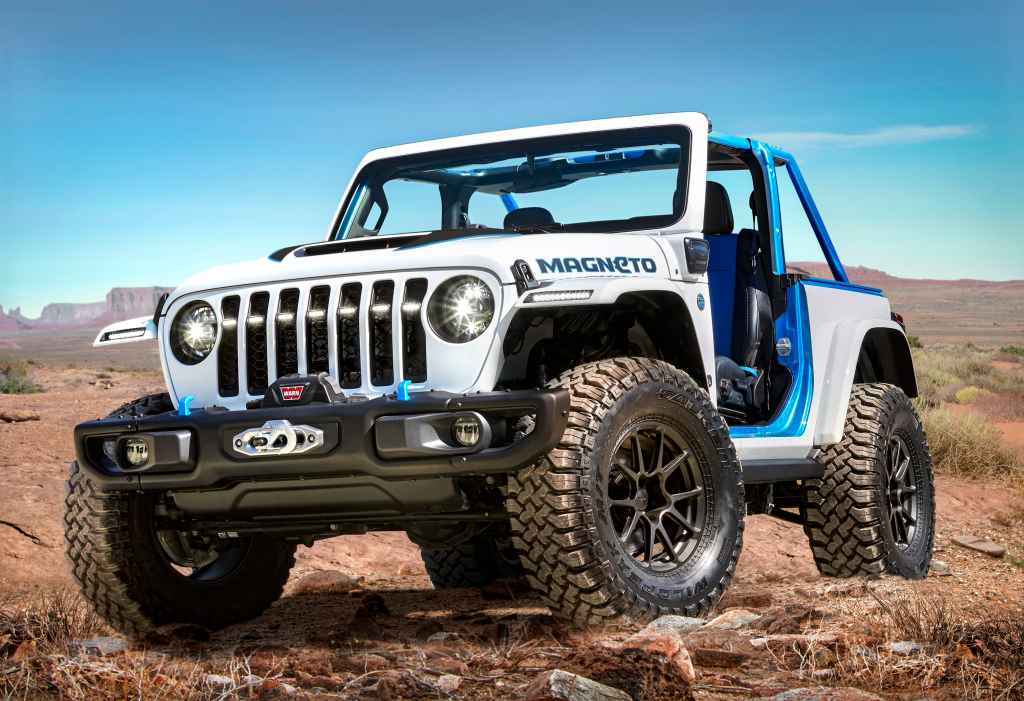
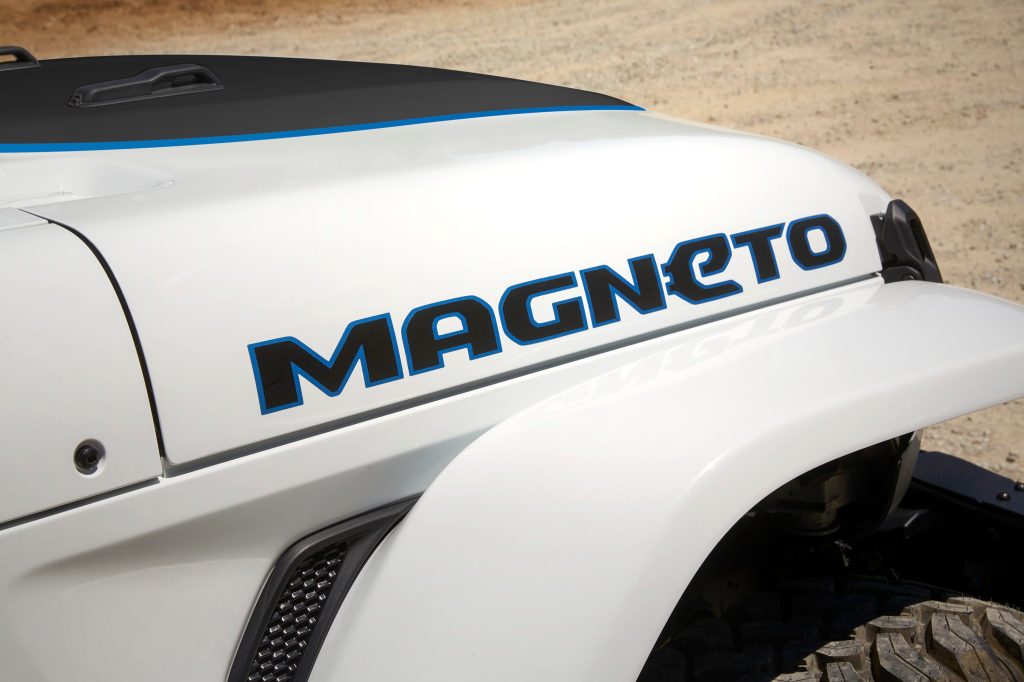
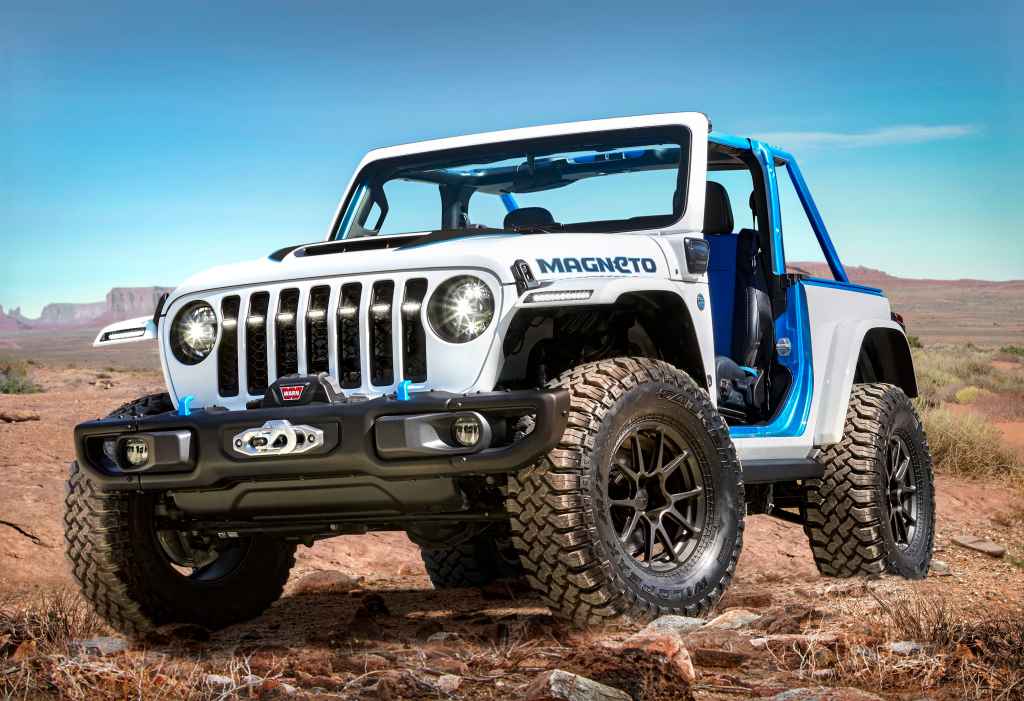
I was thrilled last night when I found out that the Jeep Magneto concept would in fact mate an electric motor to the stock JL 6-speed manual and drivelines! I have to say I’m a little salty we didn’t get a heads-up, and a chance to slap a TMGPS decal on it, but hopefully they’ll make it up to me with a chance to drive it one day. Until then, I can’t wait to find out how it does out on the trail and whether or not it’s an idea that makes sense for future production products.
Rather than crafting a homestyle copy pasta of the press release, I’m going to just let the fine folks at Jeep describe it in exactly the way they penned it.
“The Jeep Wrangler Magneto concept is a fully capable BEV that is stealthy, quiet, quick and an unmistakable rock-climbing force. Jeep brand engineers and designers have created a zero-emission vehicle with Jeep 4×4 capability that provides new levels of efficiency, environmental responsibility, and performance on- and off-road.
Based on a two-door 2020 Jeep Wrangler Rubicon, the Jeep Magneto uses a custom-built axial flux electric motor that operates up to 6,000 rpm. The e-motor is connected to a six-speed manual transmission, creating a unique manual-electric powertrain with a clutch that operates as it would with an internal combustion engine. In quick-shift scenarios, the e-motor engages regen upon clutch engagement to prevent rev-hang.
Comparable to the 3.6-liter Pentastar V-6, the compact e-motor is tuned to deliver up to 273 lb.-ft. of torque and 285 horsepower. Intentional calibrations developed during testing help the Magneto’s powertrain emulate the driving experience of the V-6, matching not only torque but also horsepower. During moderate driving, the performance difference between the V-6 and the Magneto’s unique manual-electric powertrain is negligible except for near-silent operation.
When greater acceleration is needed, the e-motor delivers all 273 lb.-ft. of torque without the need to build up revolutions per minute. The Magneto concept runs 0-60 mph in 6.8 seconds.
Powering the Jeep Magneto’s e-motor are four battery packs with a combined power of 70 kW/h, running an 800-volt system. The lithium-ion batteries are distributed around the Wrangler to balance weight on the four wheels. One pack replaces the Wrangler’s mid-ship fuel tank, another is mounted opposite the fuel tank location, the third pack sits atop the e-motor under the hood and the fourth pack mounts in the space normally used for a rear storage compartment, also using space typically occupied by the exhaust muffler.
An inverter derived from race cars converts DC power to AC for the high-tech motor. The batteries, a vehicle interface box and the battery control module all reside in waterproof enclosures to maintain the Wrangler’s 30-inch water-traversing capability. A 12-volt battery powers existing systems, such as the radio and lighting. A second 12-volt battery serves as an auxiliary power unit (APU) for accessories, such as the winch. A DC-to-DC converter charges both 12-volt batteries, allowing long-term operation of accessories to power a campsite or an unexpectedly long winch operation. Unique mounts secure the battery packs for harsh driving and custom skid plates protect the packs from potential strikes to the undercarriage while traversing harsh terrain.
A 10-kw high-voltage heater keeps the fully open-air passenger compartment comfortable.
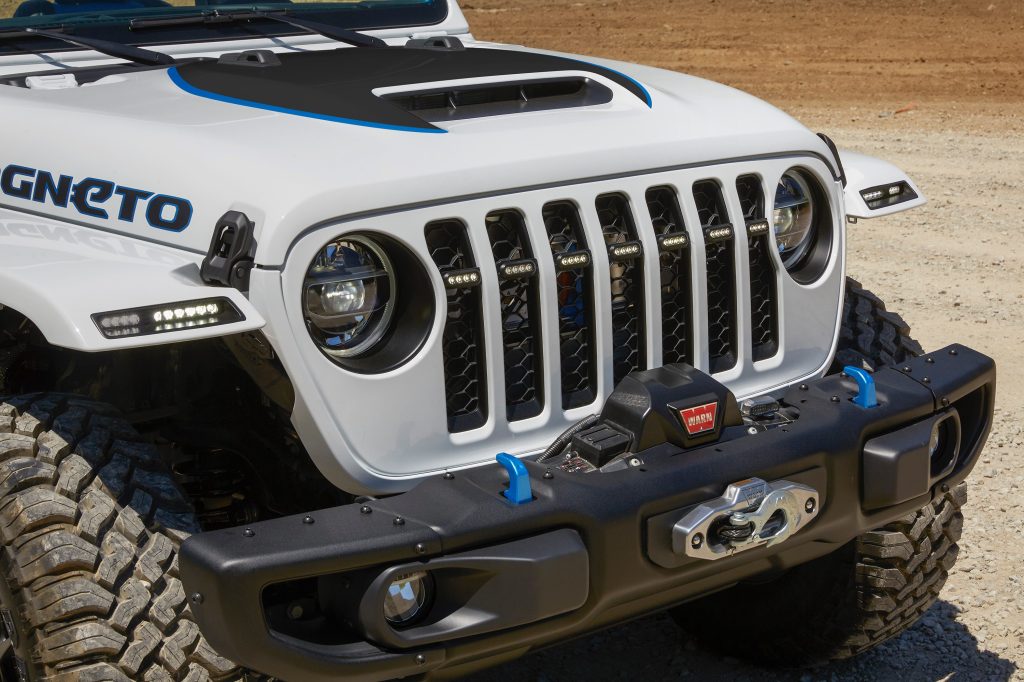
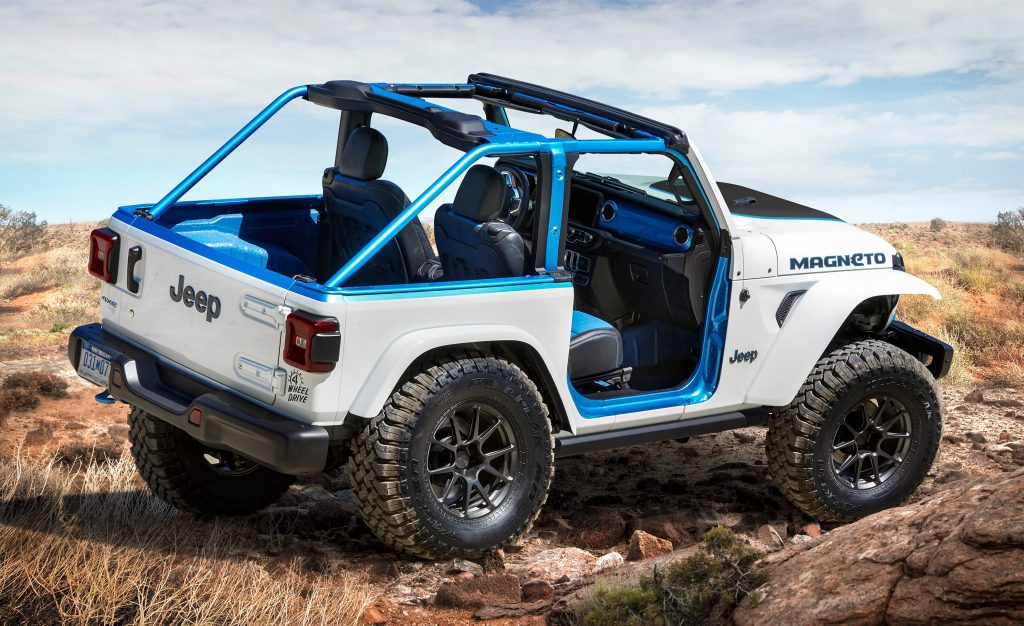
The exterior of the Magneto features a Bright White color with Surf Blue accents, along with a heavy-duty performance hood with center scoop and custom decal, redesigned rear gate and dramatic full-width forward lighting. Custom Royal Blue and Black leather seats with Sapphire-colored inserts and straps, Surf Blue truck bed liner and Mopar slush mats give the Magneto’s interior design an electrified appearance.
The Jeep Magneto comes equipped with a JPP 2-inch lift kit, 17-inch Lights Out black metallic wheels with 35-inch mud-terrain tires, custom roll cage, Mopar Rock Rails, steel bumpers with a Warn winch and a steel belly pan for added off-road capability. “
Greg Scherer could star in a Subaru brochure. His Arkansas-bred lifestyle of fly fishing, canoeing and biking New York’s remote watering holes is exactly why the Crosstrek was built. As he tells it, though, his perfect automotive match emerged out of heartbreak.
During Christmas of 2017, Greg was involved in an accident that totaled his beloved 1999 Honda Civic. Thankfully, there were no injuries, but the cost of repairs far outstripped the value of the loyal manual Honda. Pressed to find a replacement in limited time, Greg did a little soul-searching.
“While I loved my Honda, I was taking it beyond its limits,” Greg recalled, “at times being asked on a trail, “How did you get out here?” I knew I needed something much more capable in capacity to pack gear and deal with terrain.”
Greg remembered how he had eyed his friend’s 2014 Crosstrek finished in advertorial Khaki solid paint. After considering the amount of gear toting, snow plowing and puddle fording on his favorite lesser-traveled paths, Greg made a decision.
His nearest dealer was 45 minutes away. He had to know for sure the car he wanted would be in stock before he asked a friend for a ride.
“I’ll admit that initially I’d planned on getting an automatic due to the amount of traffic I dealt with,” said Greg, “but when I found out that they had the color I wanted in the trim level I wanted, and it also happened to be manual, I knew the stars had aligned for me to have another manual.”
In his first three years of ownership, Greg’s clocked 77,000 miles on his Cool Gray Khaki example. One scroll through his adventure-oriented Instagram feed proves he’s not afraid to use his car.
“My build philosophy for the car is to only replace as needed,” Greg said. “My initial enhancements came in the way of a roof rack to carry bikes, gear and my canoe. Next came an off-road-worthy set of wheels and tires once I reached 75,000 miles on the originals. I’ll keep taking it step by step as things progress naturally, and we both get older together.”
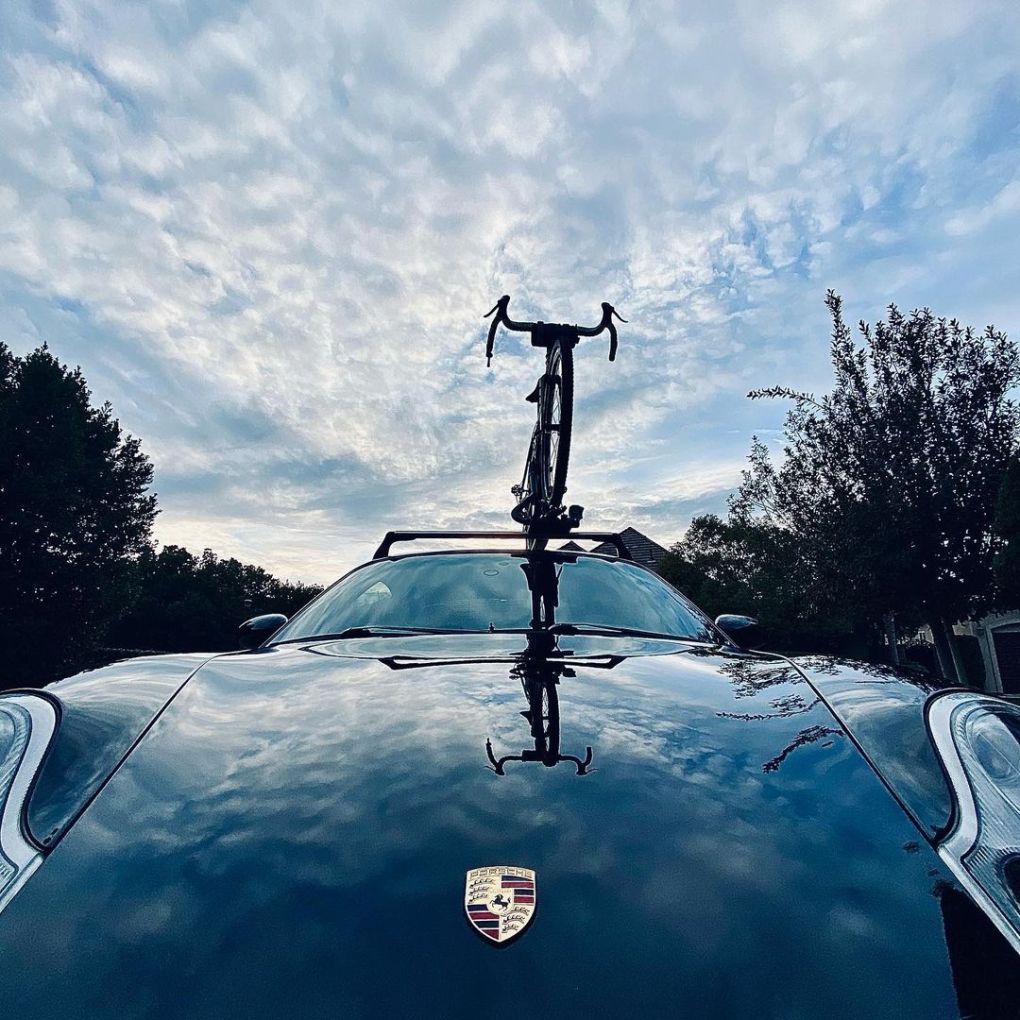
“I was looking for a car I would want to keep for life,” said Vince Santiago, owner of a 2001 Porsche 911 named Wally. Santiago was searching for a car that he could only call “well-sorted”; when he ran across Wally in the Porsche Club of America classifieds, it was an instant match.
Santiago has since logged 6000 miles on his trusty 996, performing his own annual oil change in his driveway. With fresh Mobil 1 and a Mahle filter, Santiago stands prepared for the return of 500-plus-mile roadtrips in a post-Covid world.
Wally hauls Santiago’s Cannondale bike, which regularly embarks on hour-long pedal-powered tours of the California byways. There’s something satisfying about seeing a Porsche doing blue-collar work, especially when equipped with a proper transmission.
Santiago covers California’s Porsche events on Instagram, where he uses a Leica M240 digital rangefinder camera to bring out the warmth and depth of classic lines. Most of his car show coverage is presented in full color, but when he turns his lens on Wally, moody grayscale and sepia tones bring forth the quietness of moments spent in exotic locales.
Wally wears The Manual Gearbox Preservation Society insignia on his rear windshield, a tremendous honor to those of us on the TMGPS team. Santiago found his dream car, and drives it to its fullest — a story emblematic of the Society.



 TMGPS JOURNAL
You must be logged in to post a comment.