
“Give me the most French, most manual transmission car you have.”
We skipped any pleasantries. He rose out of his seat.
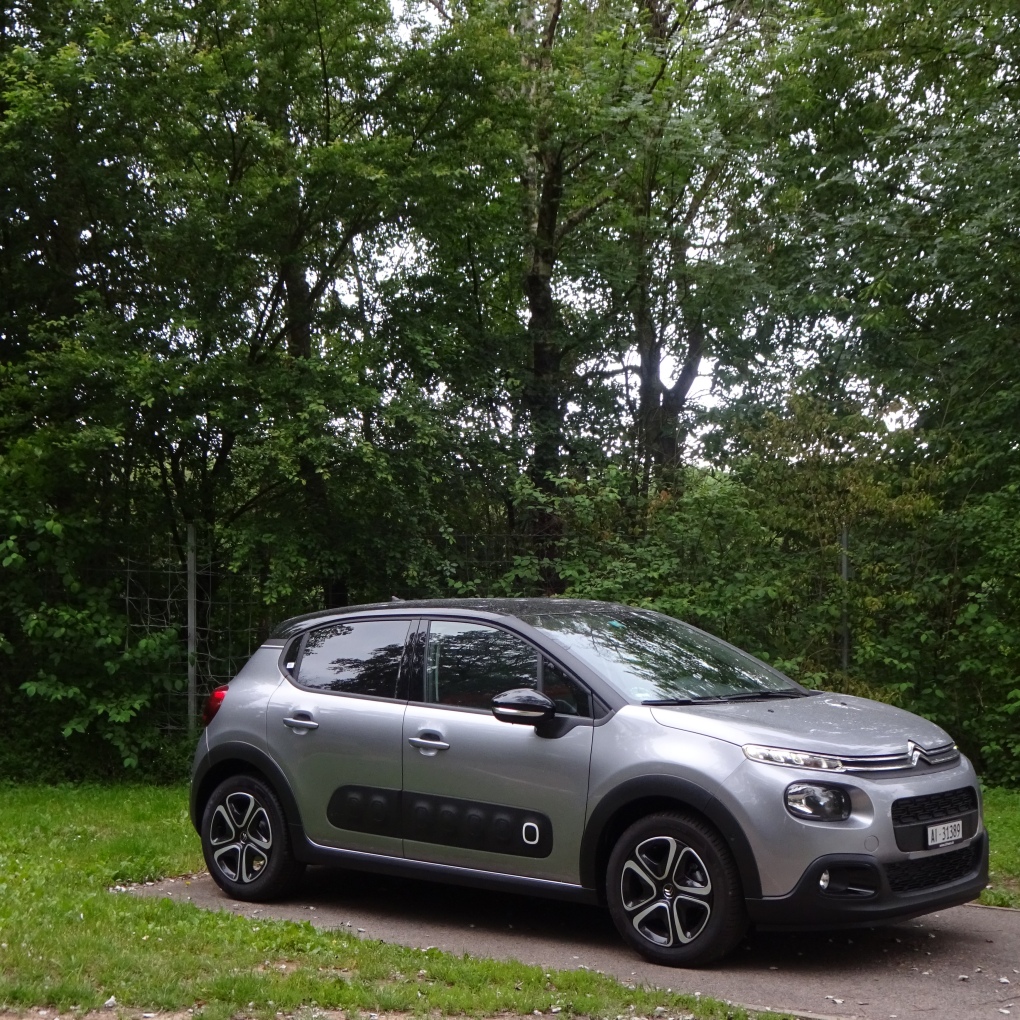
“Citroën C3. It’s hard to find a manual these days, even in Europe. It’s not a manual, but it’s French. It has eight kilometers on it and the Airbump. Don’t test the airbags. Have fun.”
At the Hertz counter in Zurich, I grasped my first set of French keys.
Mustang. Range Rover. Mazda CX-5. Space after space of familiar visage in the garage. I smiled, thinking of how rental car counter agents the world over wield such power with the click of a mouse.
I clicked the fob. I heard a beep. And then I saw a beam.
After steeping for a moment, I popped the door to climb inside. I surveyed the red dash bezel, traced the cloth seat cushion with a finger and inhaled the new car scent. I took my helm and studied the chrome chevrons on the key.
Arrested in my steps, it finally hit me: yes, I’m actually in Europe. I’m actually going to visit Peugeot. And for the next thousand kilometers, this is actually my car.
Into the ignition. A little too much switch torque, and then — a lurch!
Evidently, European safety regulations don’t mandate a clutch pedal interlock to start a car. I glanced downward, and there it was: a palm-filling square knob imprinted with a shift pattern. Hertz Guy was wrong: this C3 was a stick.
Truthfully, any pint-sized high-style compact car from a marque unavailable in the US would have charmed me from the start. But as I settled in by knocking the knob left and right from neutral, every legend about Europe being the mecca of workaday hot hatches proved true.
As I’ve traveled the world to trace the history of cars, I’ve always been struck by the cultural sameness across continents. Behind the wheel of the C3, industry-standard ergonomics made it all the easier to adapt to new traffic signs captioned in a foreign language dotting roads as narrow as they were smooth. Merging onto the motorway, not yet aware of Switzerland’s ubiquitous and vicious speed cameras, the rhythm of gear changes became a familiar bridge to learning both the car and a new set of rules for the road. As it turned out, being genuinely connected to the car through the transmission tamped down the geographic unfamiliarity. It didn’t matter I was in a foreign land and didn’t speak the language. Through a mechanical handshake, I knew I had a partner in this car.
On we went, bravely into the middle lane and soon the left. Immediately, I noticed sharp throttle response at tip-in, all too rare in an era of lazy or efficiency-focused throttle-by-wire calibration. When an engine sharply reacts to your shoe, the satisfaction of a gear change increases all the more. I marveled that Citroën engineers somehow still understood this elemental automotive truth, all but forgotten in the automatic CUVs teeming across the US.
Darting out of tunnels into sharp exits, I noticed that the C3 was still kitted with all the modern active safety conveniences: blind-spot monitoring, lane departure warning and automatic braking debunk the idea that a manual must be analog. The navitainment system offered clear and easy setup, with nothing particularly remarkable or offensive about the touch panel graphic interface. Fonts from the gauge cluster to the head unit were modern, clear and coordinated across the cabin a feat that even the latest Toyotas have yet to achieve. No longer simply avant-garde or whimsical, the C3 exhibits the importance placed upon technology in a modern Citroën modern design brief.
Technology, of course, is hardly a differentiator behind the wheel. Buyers expect seamless Apple CarPlay and Android Auto integration, and for the most part, all OEMs deliver this. Design, too, is an area where most modern OEMs have elevated their craft. The true differentiator in the 2020s is the level of engagement of the drive.
Leaning into the throttle as the highway opened up, this was my epiphany. As automakers shift their R&D resources away from vehicle dynamics to focus on autopilot systems, vehicles built to engage the driver will truly stand apart.
The C3 is a gem.
Its glint comes from the 1.2-liter turbo engine under the hood. Leaning into the throttle at lower RPM, I lamented the lack of turbo whine, but still smiled: somewhere between a growl and a grunt lay the song of the C3, a surprisingly angry bassline echoing a taxed-but-eager inline-six.
The two-hour commute to Peugeot’s Sochaux museum and factory thus became a game: find an empty stretch, scan the road for cops, heel-toe downshift with a giddy giggle and boot out a response from the mad little three-cylinder. You can’t play this game with most American subcompacts. In fact, in modern American nameplate showrooms, you can’t find a subcompact car at all.
Nor is it easy to find a neutral visage on a modern dealer lot. Among a sea of aggressive angry fascias, the C3’s stately neutrality seemed a coy dismissal of its peers. I reversed into a shady parking spot, noted the satisfying actuation and latching of the hatch and took a last look back, lamenting that PSA’s best work would never see our shores. Quelle tragédie.
###
Months later, a surprise merger with FCA may mean that Peugeot and Citroën platforms have a path to North America after all. Several questions arise: Will a Citroën with a Chrysler badge lose its European appeal? More vital: Will PSA realize that bringing manual transmission models to the United States is a fast path to differentiation in a highly competitive market? As PSA and FCA plan Peugeot’s re-entry into the US, manual transmission fans have one last chance to shape the automotive landscape for those who still care to drive.
 TMGPS JOURNAL